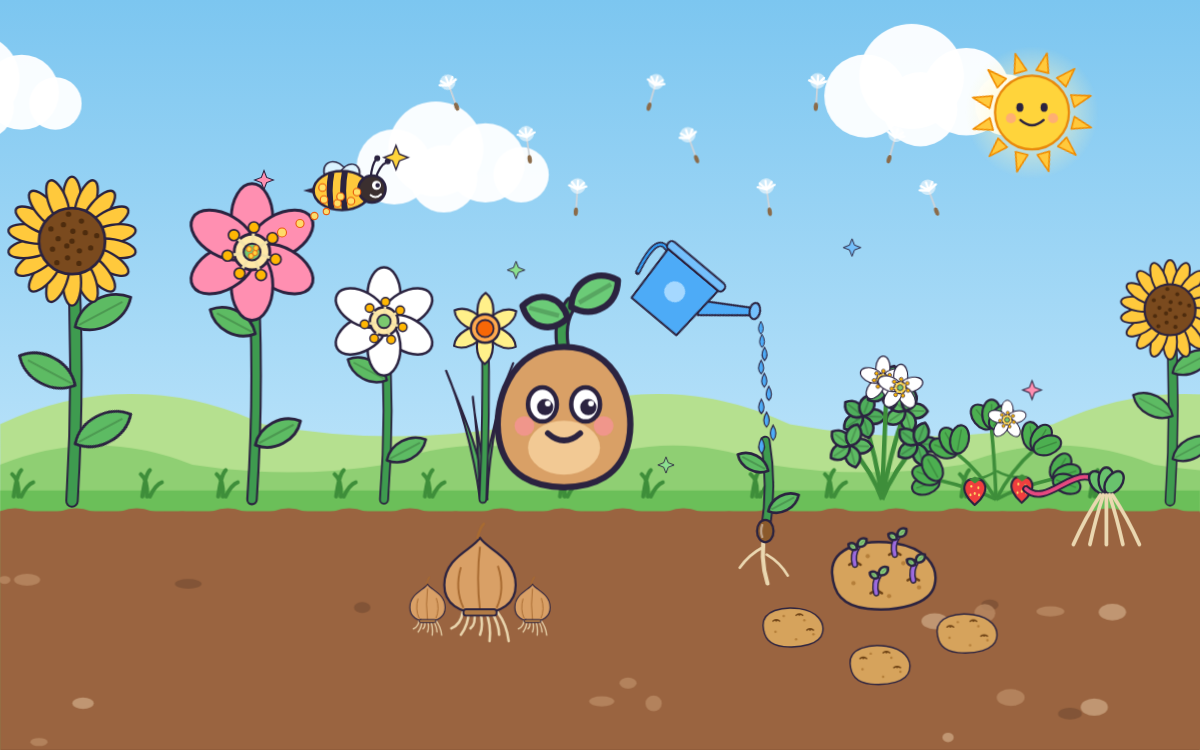
What you'll learn
- What reproduction means, and the words parent plant and offspring
- How pollination and fertilisation let a flower make seeds
- The flowering plant life cycle, from pollination to germination
- How bulbs and tubers store food and grow new plants
- How to grow a new plant from a runner or a cutting
- The difference between sexual and asexual reproduction in plants
Chapter by chapter
- Why plants reproduce: parents and offspring
Year 5 science · 1
- How flowers make seeds: pollination to germination
Year 5 science · 1
- New plants from bulbs and tubers
Year 5 science · 1
- New plants from runners and cuttings
Year 5 science · 1
- Seeds and copies: two parents or one
Year 5 science · 1
- Final quiz: how plants reproduce (10 questions)
What the chapters cover in the national curriculum in England:
- Year 5 science: Describe the life process of reproduction in some plants and animals
About this adventure
How Plants Reproduce is an interactive science game that teaches children aged 8–11 how flowering plants make seeds and how new plants grow from bulbs, tubers, runners and cuttings. It follows the Year 5 science curriculum for England.
Players guide a bee between flowers to see pollination, watch a pollen tube reach an ovule for fertilisation, and spread seeds by wind and by bird. They slice open a daffodil bulb, sprout a potato tuber, root a strawberry runner and take a mint cutting step by step, as a gardener would.
Along the way they learn that seeds come from two parents, so seedlings can look a little different, while bulbs, tubers, runners and cuttings make copies of one parent plant. A narrator reads every step aloud, and a 10-question final quiz, including spelling the key words, checks what they remember.
Questions and answers
How do plants reproduce, in simple words?
Plants reproduce in two main ways. Flowering plants make seeds after pollen from one flower joins an ovule in another, while some plants grow copies of themselves from bulbs, tubers, runners or cuttings, which need only one parent.
What is the difference between pollination and fertilisation?
Pollination is when pollen moves from the anther of one flower to the sticky stigma of another, often carried by insects or the wind. Fertilisation happens afterwards, when a pollen tube grows down and the pollen joins an ovule, which can then become a seed.
What is asexual reproduction in plants?
Asexual reproduction is when a new plant grows from just one parent, so it is an exact copy of that parent. Daffodil bulbs, potato tubers, strawberry runners and stem cuttings are all examples of plants reproducing this way.
What age is this plant reproduction game for?
The game suits children aged 8 to 11 and matches the Year 5 science curriculum in England. Younger players can follow along because every instruction is read aloud and the screens use short sentences and lots of tapping, dragging and sorting.
What does the game include and how long does it take?
It has five chapters and a 10-question final quiz, and takes about 40 minutes to play through. Players can pick any chapter from the garden map, stop at any time and carry on later from where they left off.
More to explore
See all
Animal Adaptations: Survive Every Habitat with Kiko
Learn how animal adaptations help living things survive deserts, ice, oceans and rainforests by swapping habi…
Classifying Living Things: A Nature Sort with Hoot
Learn how to group living things and use classification keys to name them, by sorting animals and plants and…
How Water Travels Through Plants: A Raindrop's Journey
Learn how water travels through plants, from the roots up to the leaves. Make it rain, zoom into root hairs a…
Pollination and Seed Dispersal: A Bumblebee Adventure
Learn how pollination and seed dispersal work: fly Bramble the bumblebee between flowers, grow fruit and send…
Food Chains: Build a World and Find Out Who Eats Whom
Learn how food chains work by building a living world: grow grass with sunlight, feed a hungry rabbit, meet a…
Animal Habitats: Build a Woodland with Dotty the Ladybird
Discover how animal habitats give living things food, water and shelter, as you build a woodland, match anima…
Skeletons and Muscles: Build a Body with Skelly
Learn how skeletons and muscles work together: build a skeleton, test how bones protect you, and make an arm…
 TapLearn