The Digestive System: Follow Your Lunch with Pip
Learn how the digestive system works, from teeth to intestines, as you follow Gus's lunch through his body with Pip the tiny explorer.
- Ages 7–10
- About 35 min
- Some thinking
- Human Body
Learn how the digestive system works, from teeth to intestines, as you follow Gus's lunch through his body with Pip the tiny explorer.
This interactive digestive system game teaches children aged 7–10 how food travels through the body, from the mouth to the intestines, and what each part does along the way. It follows the KS2 Year 4 science curriculum.
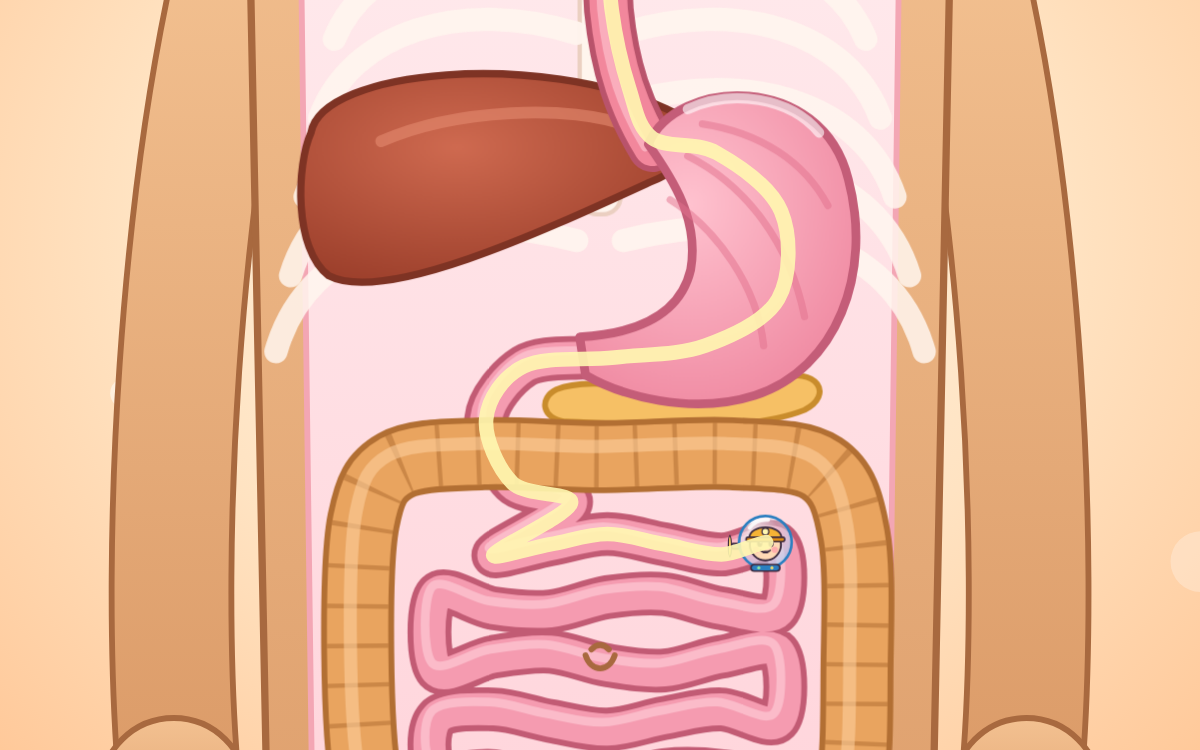
Players shrink down with Pip and ride along inside Gus, a friendly giant, as he eats his lunch. They bite with incisors, tear with canines and grind with molars, match a lion's and a sheep's teeth to their food, and scrub sugar bugs off teeth. Next they close the epiglottis, a flap that keeps food out of the windpipe, and tap muscle rings to squeeze food down the oesophagus.
In the stomach they add acid juices and churn lunch into soup. In the small intestine they drag goodness into the villi, tiny finger-like bumps that pass it into the blood. Then the large intestine soaks up water and the waste is flushed away.
The digestive system breaks food down so your body can use it. Teeth and saliva start the job in the mouth, the oesophagus squeezes food down to the stomach, the stomach churns it into a soup, the small intestine passes goodness into the blood and the large intestine takes out water.
Incisors, canines and molars are the three main types of teeth. Flat incisors at the front cut and bite, pointy canines grip and tear, and wide, bumpy molars at the back crush and grind food into small pieces.
Your stomach sits high up in your body, just under your ribs on the left side, not behind your belly button. It is a stretchy, muscly bag that mixes food with strong acid juices.
The game is designed for children aged 7 to 10 and matches the Year 4 science topic on the digestive system and teeth. Everything is narrated aloud with captions, so younger players can follow along, and older children can use it for revision.
It includes five short chapters on teeth, tooth care, swallowing, the stomach and the intestines, followed by a 10-question final challenge and a recap finale. Playing everything takes about 35 minutes, and players can start with any chapter.
 TapLearn
Getting it ready…
You've played chapter 1 for free. Ask a grown-up to make a free family account and become a member to open every chapter of every game.
Ask a grown-up to make a free family account and become a member to open every chapter of every game. There are lots of free games to play too!