What you'll learn
- What an adaptation is: an inherited feature or behaviour
- The difference between body features and behaviours
- Why camels store fat and cactus spines save water
- Why small ears keep Arctic foxes warm and big ears cool desert foxes
- Why fish use gills while dolphins breathe air with lungs
- How the peppered moth shows adaptation leading to evolution
Chapter by chapter
- Adaptations: body features and behaviours
Year 6 science · 1
- Desert adaptations: heat, sand and little water
Year 6 science · 1
- Polar adaptations: keeping warm in the cold
Year 6 science · 1
- Ocean adaptations: gills, lungs and streamlined bodies
Year 6 science · 1
- Rainforest adaptations: rain, shade and crowded trees
Year 6 science · 1
- How adaptation leads to evolution
Year 6 science · 1
- Survival Expert Challenge (10 questions)
What the chapters cover in the national curriculum in England:
- Year 6 science: Identify how animals and plants are adapted to suit their environment in different ways and that adaptation may lead to evolution
About this adventure
Animal Adaptations is an interactive science game that teaches children aged 9–11 how animals and plants are adapted to deserts, polar lands, oceans and rainforests, and how adaptation can lead to evolution. It follows the Year 6 science curriculum for England.
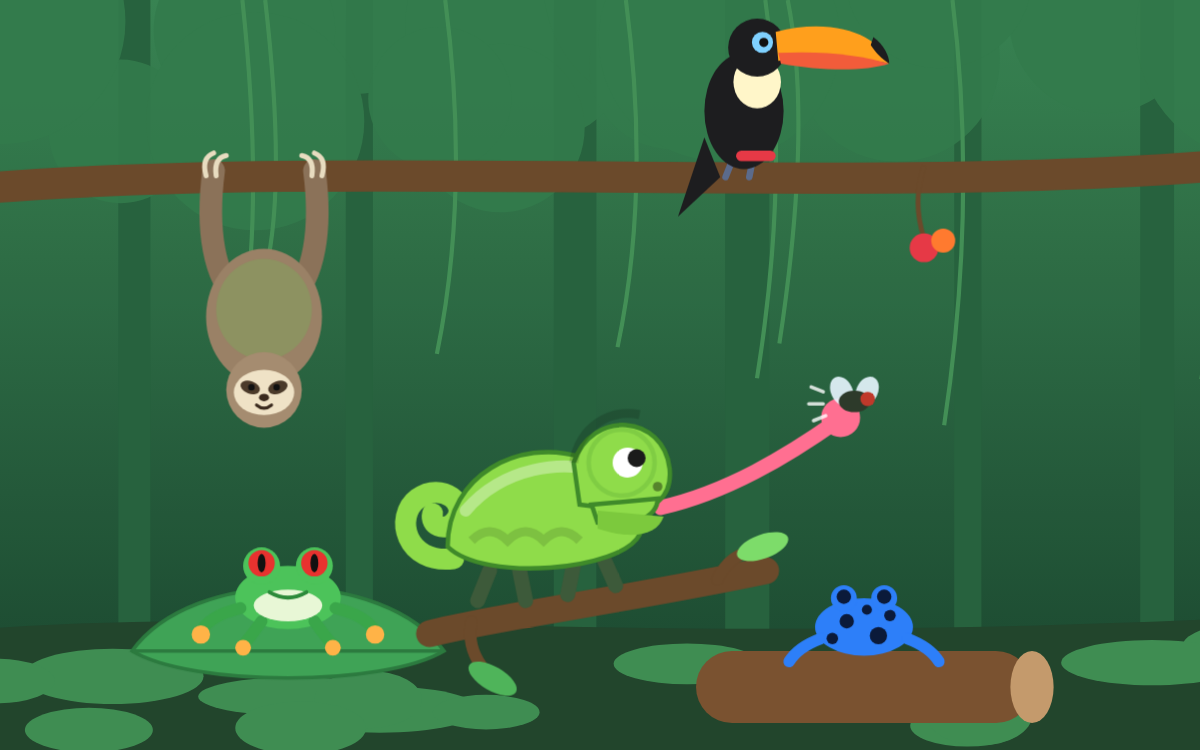
Guided by Kiko the chameleon, players swap a polar bear and a camel between homes, change a fox's ear size to see heat escape, build a penguin huddle and race different body shapes through water. They learn that an adaptation is an inherited body feature or behaviour that helps a living thing survive, and they meet plant adaptations such as cactus spines, drip tips and tendrils.
In the final chapter, children play a hungry bird hunting peppered moths on sooty bark, watch dark moths become common over many generations and test the giraffe-stretching myth. Each chapter is narrated, with short questions and typed answers to check understanding.
Questions and answers
What is an animal adaptation, in simple words?
An adaptation is a body feature or behaviour that helps a living thing survive in its environment. A polar bear's thick fur is a body feature, while penguins huddling together is a behaviour. Living things inherit adaptations from their parents; they cannot choose them.
How does adaptation lead to evolution?
Adaptation leads to evolution when the best-suited individuals survive and pass their features to their young. Because living things vary, a change in the environment favours some of them, and over many generations the whole species slowly changes.
How are animals adapted to living in the desert?
Desert animals are adapted to heat, sand and very little water. A camel's hump stores fat for energy and its long eyelashes keep out sand, while a fennec fox's big ears let body heat escape and it hunts at night.
What age is this adaptations game for?
The game is designed for children aged 9 to 11. It matches the Year 6 science objective on adaptation and evolution in the national curriculum for England, and keen younger children can enjoy it with an adult.
What does the game include and how long does it take?
The game has six narrated chapters, each with an animated introduction, hands-on activities and quick checks, plus a ten-question final challenge. Playing everything takes about 50 minutes, and children can start any chapter from the map.

 TapLearn