What's inside
- Thirsty Roots
- The Stem Highway
- The Colour Lab
- The Leaf Escape
- Plant Doctor Challenge 8 questions
What you'll learn
- How root hairs soak up water from the soil like a sponge
- How tiny tubes in the stem carry water up to leaves and flowers
- The order of water's journey: soil, roots, stem, leaves
- Why a white flower changes colour when it stands in coloured water
- How water escapes from leaves as water vapour through tiny holes
- Why plants wilt without water and stand tall again when watered
About this adventure
How Water Travels Through Plants is a free interactive game that teaches children aged 6–9 how water moves from the soil, through the roots and up the stem to the leaves and flowers. It follows the Year 3 Plants unit of the UK National Curriculum, and every line is read aloud and shown as a caption.
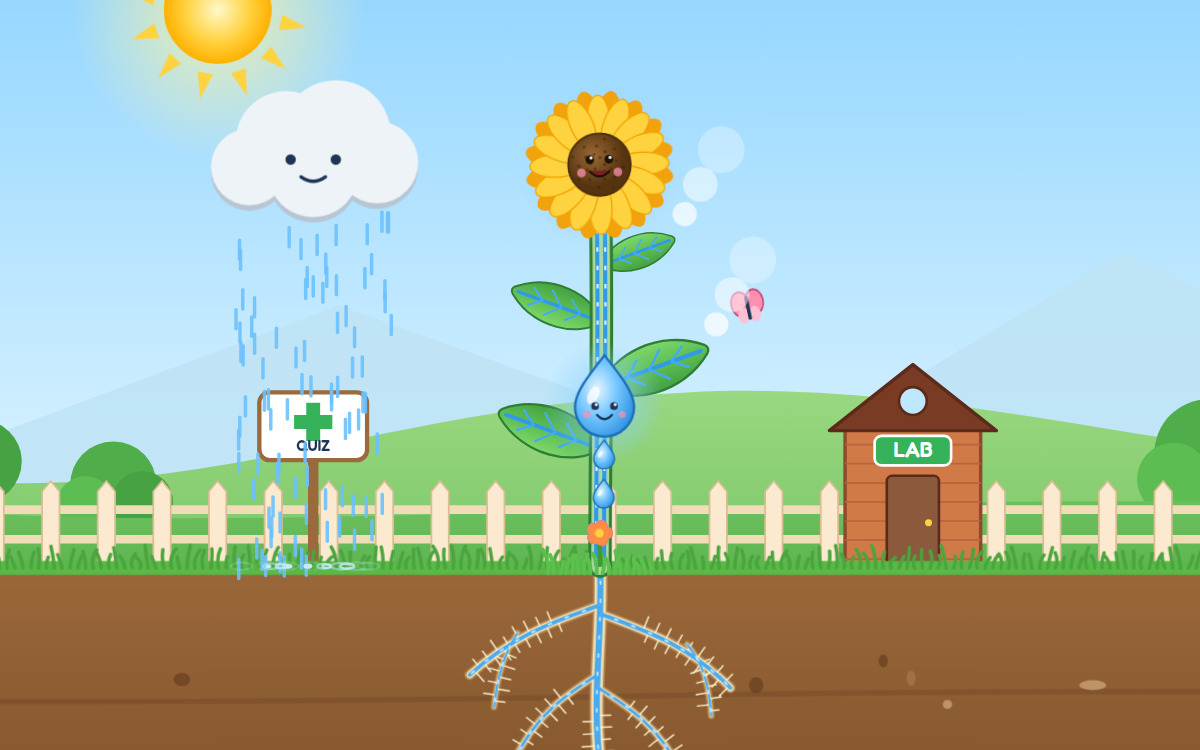
Players travel with Dewy, a water drop, to help a drooping sunflower. They make it rain, drag drops onto root hairs that soak up water like a sponge, cut the stem to find the tiny tubes that carry water upwards, and watch what happens in a drought. In the Colour Lab they run a fair test with a white flower and a celery stick standing in coloured water.
Finally they open tiny holes in a leaf to let water escape as water vapour, then try the 8-question Plant Doctor challenge.
Questions and answers
How does water travel through a plant, in simple words?
Water goes from the soil into the roots, then up the stem through tiny tubes to the leaves and flowers. Root hairs soak the water up, and water escapes from tiny holes in the leaves as water vapour, which helps pull more water up behind it.
Why does a white flower change colour in coloured water?
A white flower changes colour because the coloured water travels up tiny tubes in its stem to the petals. The change takes hours rather than seconds, and cutting a celery stick that stood in coloured water shows a ring of coloured dots where those tubes are.
Why do plants wilt when they don't get enough water?
Plants wilt because the water inside them helps keep them firm, so when the soil dries out and no water comes up the stem, the leaves and flowers droop. Watering the soil near the roots usually helps the plant stand tall again.
What age is this plants and water game for?
The game is designed for children aged about 6 to 9 and matches the Year 3 Plants unit of the UK National Curriculum for KS2 science. Every instruction is spoken aloud with captions, so children who are still building their reading confidence can follow along.
What does the game include and how long does it take to play?
The game has four chapters, an 8-question Plant Doctor challenge, and an animated intro and finale. Playing everything takes about 30 minutes. Children can start any chapter from the garden map and go back to the map at any time.
Next in Plants
See all

Food Chains: Build a World and Find Out Who Eats Whom
Learn how food chains work by building a living world: grow grass with sunlight, feed a hungry rabbit, meet a…
Animal Habitats: Build a Woodland with Dotty the Ladybird
Discover how animal habitats give living things food, water and shelter, as you build a woodland, match anima…
Place Value to a Million: A Rocket Mission with Pip
Learn place value to a million and how to count in powers of 10. Build blocks, set digits on a place value ch…
Adding and Subtracting: Hop Along with Hopper the Frog
Learn adding and subtracting with number bonds, number lines and columns, then tap, hop and exchange counters…
How Computers Work: A Time Machine Adventure with Bit
Learn how computers work, from the abacus to the CPU. Travel through time with Bit, build a computer and foll…
Instruments of the Orchestra: Build It, Then Conduct It
Learn how the instruments of the orchestra make their sounds, then build all four families step by step and c…