What you'll learn
- Spot direct speech: the exact words a character says
- Why speech marks are also called inverted commas
- Write opening inverted commas like 66 and closing ones like 99
- Put inverted commas around the spoken words, not around 'said Ben'
- Keep the comma, question mark or exclamation mark inside the speech marks
- Choose words like whispered or shouted to show how something is said
What's inside
- Who Said That?
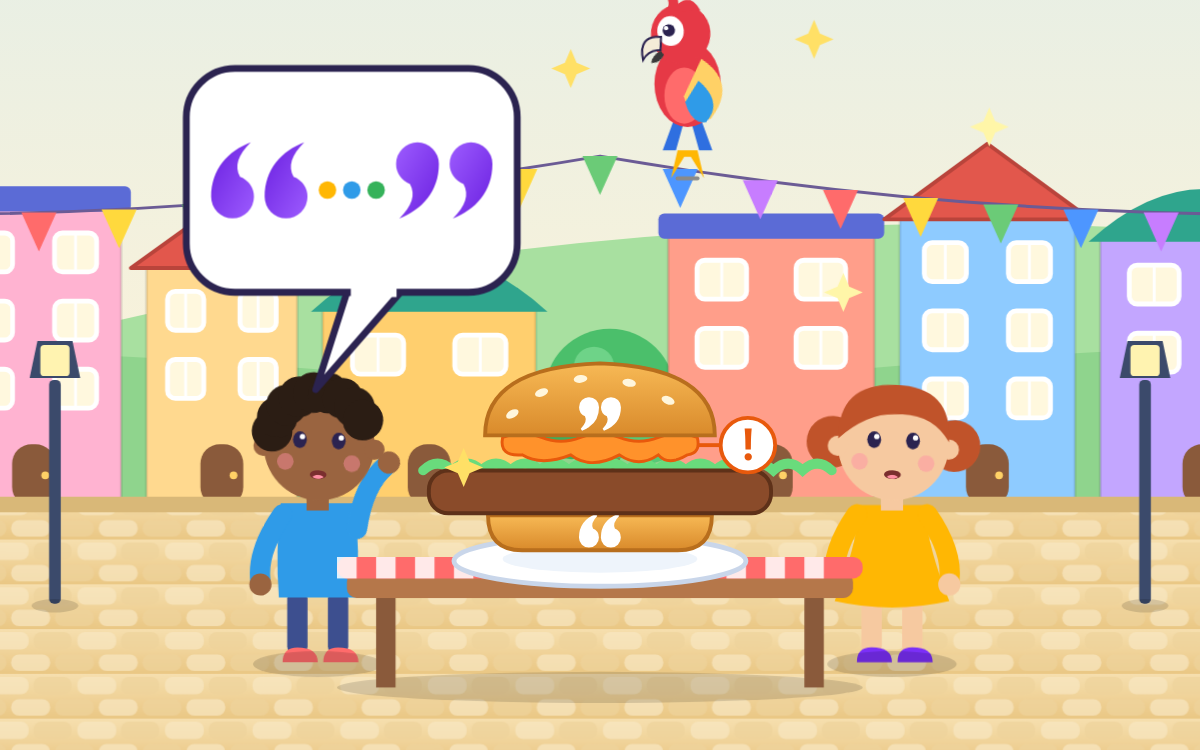
- Meet 66 and 99
- Catch the Words
- The Speech Sandwich
- Speech Detective Challenge (8 questions)
About this adventure
Speech Marks: Catch the Words is a free interactive game that teaches children aged 7–9 how to use speech marks, also called inverted commas, to show direct speech. In Chatterbox Village, Pip the parrot copies the exact words people say. That 'parrot test' helps children work out which words belong inside the marks.
Players tap the spoken words in a sentence and turn a comma upside down to see why the marks are called 'inverted'. They trace a 6 and a 9 to learn that opening marks look like 66 and closing marks look like 99. Next, they drag the marks around characters' words and build a speech sandwich that keeps the punctuation inside. They also choose words like whispered or shouted.
A final Speech Detective challenge of eight cases checks what they have learned. Every line is read aloud, and the game follows the Year 3 English curriculum.
Questions and answers
What are speech marks?
Speech marks, also called inverted commas, are punctuation marks that go around the exact words someone says in a piece of writing. They show readers where the speech starts and ends, doing the job that a speech bubble does in a comic.
Where do speech marks go in a sentence?
Speech marks go around only the words that are actually spoken, not around words like 'said Mia'. For example: “I found a shell!” said Mia. The opening marks go just before the first spoken word, and the closing marks go just after the last one.
Does punctuation go inside or outside speech marks?
The comma, question mark or exclamation mark that ends the speech goes inside the closing speech marks, as in “Can I come?” asked Mia. Children meet inverted commas in Year 3 and practise this punctuation rule more fully in Year 4.
What age is this speech marks game for?
It is made for children aged 7 to 9, matching Year 3 English in England, where inverted commas for direct speech are first introduced. Older children who still mix up where speech marks go can use it for extra practice too.
What does the speech marks game include and how long does it take?
The game has four short chapters and an eight-case Speech Detective challenge, and takes about 35 minutes to play in full. Children can start any chapter from the village map, and their progress is saved.