Past and Present Tense
A Time Trip with Tock the Clock
Learn when to use past and present tense by pulling a time lever, feeding verbs into an -ed machine and fixing tense mix-ups as a time detective.
- Ages 6–8
- About 25 min
- 5 chapters + quiz
- Easy start
- Grammar & Punctuation
What's inside
- Now or Then?
- The -ed Machine
- Tricky Twisters
- Busy Right Now!
- Time Detective
- Now or Then?: your turn 4 questions
- The -ed Machine: your turn 4 questions
- Tricky Twisters: your turn 5 questions
- Busy Right Now!: your turn 5 questions
- Time Detective: your turn 5 questions
What you'll learn
- What a verb is and how its tense shows when things happen
- How time words like yesterday and every day signal past or present
- Four spelling rules for adding -ed: jumped, baked, hopped, cried
- Irregular past tense verbs such as went, saw, ate and ran
- When to use is, are, was or were with -ing verbs
- How to keep one tense in a sentence and fix mix-ups
About this adventure
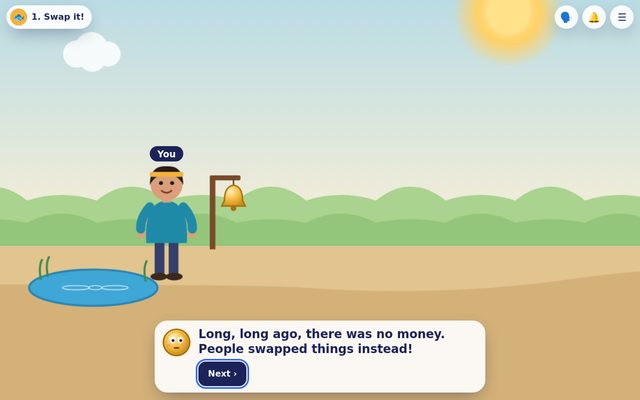
Past and Present Tense is a free interactive game that teaches children aged 6–8 how to tell whether something is happening now or has already happened, and how to change verbs to match. Tock, a friendly talking clock, guides players one step at a time through five short lessons.
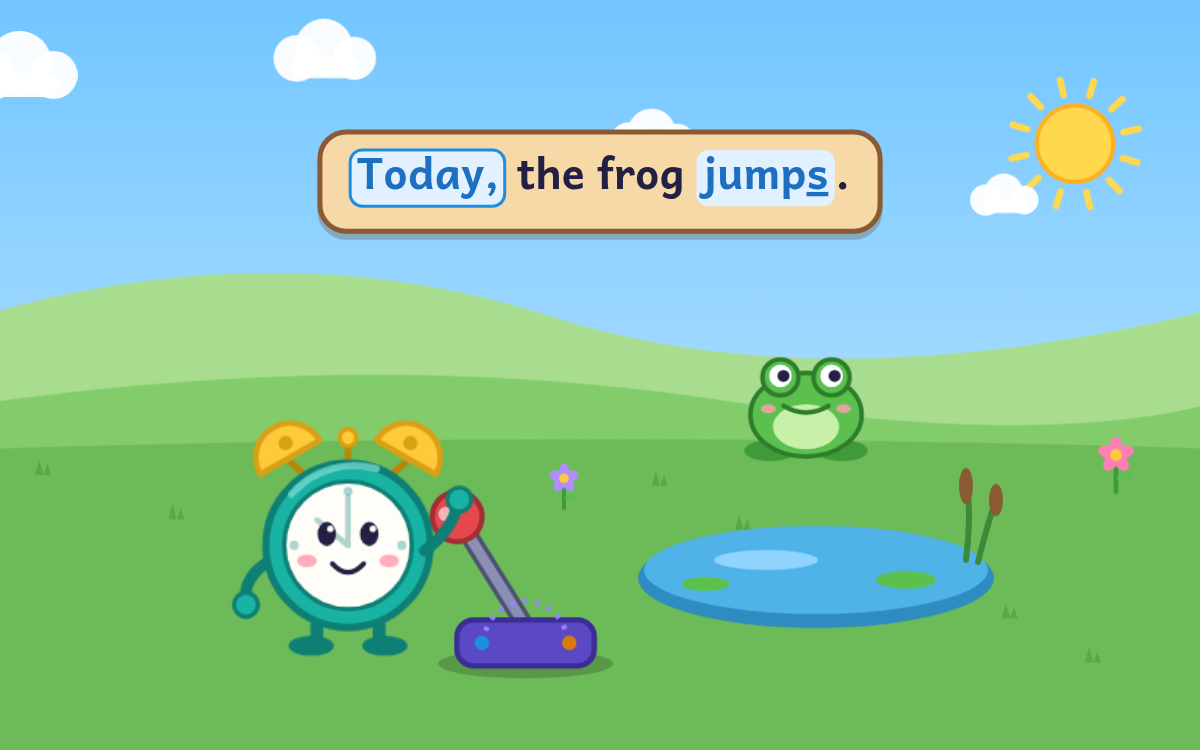
Players pull a time lever to jump into yesterday and drag word tiles into sentences. A machine shows the -ed spelling rules: add -ed (jump, jumped), add only d after e (bake, baked), double the last letter (hop, hopped) or change y to i (cry, cried). Irregular verbs, which change instead of taking -ed, spin through a twister (go, went). Players also choose is, are, was or were before -ing verbs, and fix sentences that mix two tenses.
Each lesson ends with a short challenge worth up to three stars, and every instruction is read aloud.
Questions and answers
What is the difference between past and present tense?
Present tense tells us something is happening now or happens regularly, like 'the frog jumps'. Past tense tells us it has already happened, like 'the frog jumped'. Time words such as today, yesterday or last night are clues to which tense a sentence needs.
How do you add -ed to a verb?
Most verbs just add -ed, so jump becomes jumped. If the verb ends in e, add only d (bake, baked). Short verbs with one vowel before the last consonant double that letter (hop, hopped), and verbs ending in a consonant plus y change y to i (cry, cried).
What are irregular past tense verbs?
Irregular verbs do not take -ed in the past tense; they change to a new word instead. Common examples children meet early are go and went, see and saw, eat and ate, run and ran, and make and made. Saying 'goed' is a typical mistake while learning.
What age is this past and present tense game for?
It is designed for children aged 6 to 8 and matches Year 2 English grammar in England, where pupils learn to use past and present tense correctly, including the -ing progressive form. Older children who find tenses tricky can also use it for revision.
How long does the game take and what does it include?
Playing all five lessons takes about 25 minutes. Each one is guided by Tock the talking clock and finishes with a challenge worth up to three stars, and the game works on phones, tablets and computers with touch, mouse or keyboard.
Next in Grammar & Punctuation
See all
Capital Letters and Full Stops: A Sentence Train Adventure
Learn how capital letters and full stops make a sentence, then build sentence trains, fix capitals and join i…
Adverbs of Time, Place and Cause: Pip's Island Quest
Learn how adverbs of time, place and cause tell us when, where and why. Grow a sunflower, find a hiding kitte…
Prepositions and Conjunctions: A Busy Day with Pip
Learn prepositions and conjunctions for time, place and cause, then help Pip the robin and Mo the kitten buil…
Place Value to a Million: A Rocket Mission with Pip
Learn place value to a million and how to count in powers of 10. Build blocks, set digits on a place value ch…
How Computers Work: A Time Machine Adventure with Bit
Learn how computers work, from the abacus to the CPU. Travel through time with Bit, build a computer and foll…
Adding and Subtracting: Hop Along with Hopper the Frog
Learn adding and subtracting with number bonds, number lines and columns, then tap, hop and exchange counters…