Year 3 and 4 Spelling
Sail the Spell Isles with Pip
Learn the Year 3 and 4 spelling rules, from prefixes and suffixes to homophones, by building words, tapping drums and sorting trains across eight islands.
- Ages 7–9
- About 60 min
- 8 chapters + quiz
- Some thinking
- Phonics & Spelling
What's inside
- Prefix Bridge
- Beat Beach
- Suffix Workshop
- Shun Station
- Detective Cove
- Homophone Harbour
- Apostrophe Farm
- Tricky Word Tower
- Grand Spelling Challenge 10 questions
What you'll learn
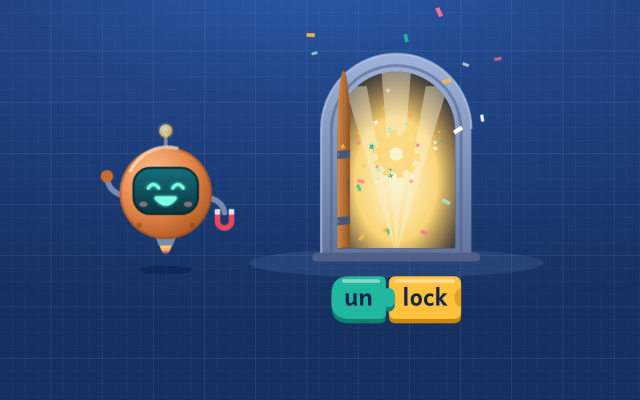
- How prefixes like dis-, mis- and il-, im-, ir- change meaning
- When to double the last letter, using the stressed syllable
- How to add -ly, -ation and -ous without common slips
- Choosing -tion, -sion, -ssion or -cian from the root word's ending
- Picking the right homophone, such as peace or piece, by meaning
- Where the apostrophe goes for plural owners, as in girls' and children's
About this adventure
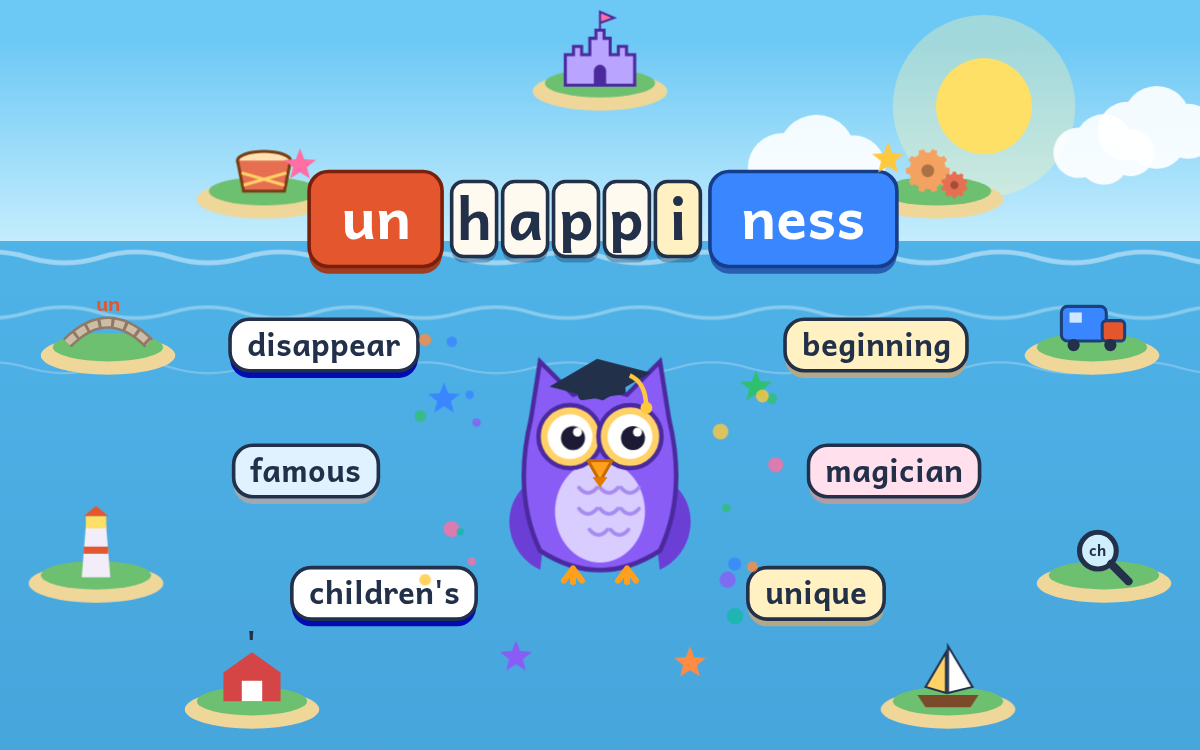
Year 3 and 4 Spelling is a free interactive game that teaches children aged 7–9 the spelling rules and statutory word list from the KS2 National Curriculum for England. Guided by Pip the word owl, players sail between eight islands. Each island teaches one spelling pattern through hands-on tasks, then ends with a short practice round.
Players drag prefix stones onto root words. They tap drums to find the stressed syllable, which tells them when to double a letter. They pull levers on suffix machines and send trains to -tion, -sion, -ssion or -cian platforms. Other islands cover words borrowed from Greek, French and Latin, homophones such as peace and piece, apostrophes for plural owners, and memory tricks for the 100 statutory words.
A ten-question Grand Challenge mixes questions from every island, and a narrator reads each instruction aloud.
Questions and answers
What spelling rules do children learn in Year 3 and 4?
In Years 3 and 4, children learn prefixes such as dis-, mis- and in-, suffixes such as -ly, -ation and -ous, and the -tion, -sion, -ssion and -cian endings. They also study homophones, plural possessive apostrophes, unusual spellings like the y in gym, and 100 statutory words.
When do you double the last letter before adding -ing or -ed?
Double the last consonant when the final syllable is stressed and ends in one vowel followed by one consonant, as in begin becoming beginning. If the stress falls on an earlier syllable, as in garden, just add the ending to make gardening.
Where does the apostrophe go when there is more than one owner?
If the plural already ends in s, the apostrophe goes after the s, as in the girls' coats. If the plural does not end in s, such as children or women, add an apostrophe and then s, as in the children's toys.
What age is this spelling game for?
The game is designed for children aged 7 to 9, matching Years 3 and 4 of the National Curriculum in England. Older children who need a refresher on these spelling patterns can use it too, because every island begins with a short guided explanation.
How long does the game take, and what does it include?
Playing everything takes about an hour: eight islands of roughly five to eight minutes each, plus a ten-question Grand Challenge. Children can start from any island, return to the map at any time, and pick up where they left off.
Next in Phonics & Spelling
See all
Past and Present Tense: A Time Trip with Tock the Clock
Learn when to use past and present tense by pulling a time lever, feeding verbs into an -ed machine and fixin…
Place Value to a Million: A Rocket Mission with Pip
Learn place value to a million and how to count in powers of 10. Build blocks, set digits on a place value ch…
Adding and Subtracting: Hop Along with Hopper the Frog
Learn adding and subtracting with number bonds, number lines and columns, then tap, hop and exchange counters…
How Computers Work: A Time Machine Adventure with Bit
Learn how computers work, from the abacus to the CPU. Travel through time with Bit, build a computer and foll…
Instruments of the Orchestra: Build It, Then Conduct It
Learn how the instruments of the orchestra make their sounds, then build all four families step by step and c…
How Money Works: The Story from Barter to Bank Cards
Learn where money came from and how it works today: swap goods, mint coins, open a bank and tap to pay, one s…