Capital Letters and Full Stops
A Sentence Train Adventure
Learn how capital letters and full stops make a sentence, then build sentence trains, fix capitals and join ideas with “and” alongside Dot.
- Ages 5–7
- About 35 min
- 13 chapters + quiz
- Easy start
- Grammar & Punctuation
What's inside
- Your first sentence
- Build it yourself
- Does it make sense?
- Small and big letters
- Capital partners
- Where capitals go
- Fix the capitals
- Meet Buzzy the bee
- Where does Dot go?
- Sentence detective
- Build the and bridge
- Join the ideas
- What comes next?
- Climb Star Mountain 6 questions
What you'll learn
- A sentence is a group of words that makes sense
- Every sentence starts with a capital letter and ends with a full stop
- Capital letters for names, places, days of the week and the word I
- Where to put a full stop when an idea ends
- How the joining word “and” links two ideas into one sentence
- Matching each small letter to its capital letter
About this adventure
Capital Letters and Full Stops is a free interactive game that teaches children aged 5–7 how to build a sentence, matching Year 1 English in the National Curriculum. Players learn that a sentence makes sense, begins with a capital letter and ends with a full stop, and how the joining word “and” links two ideas.
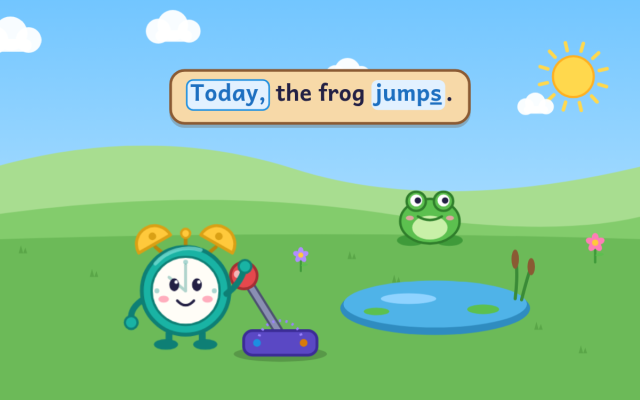
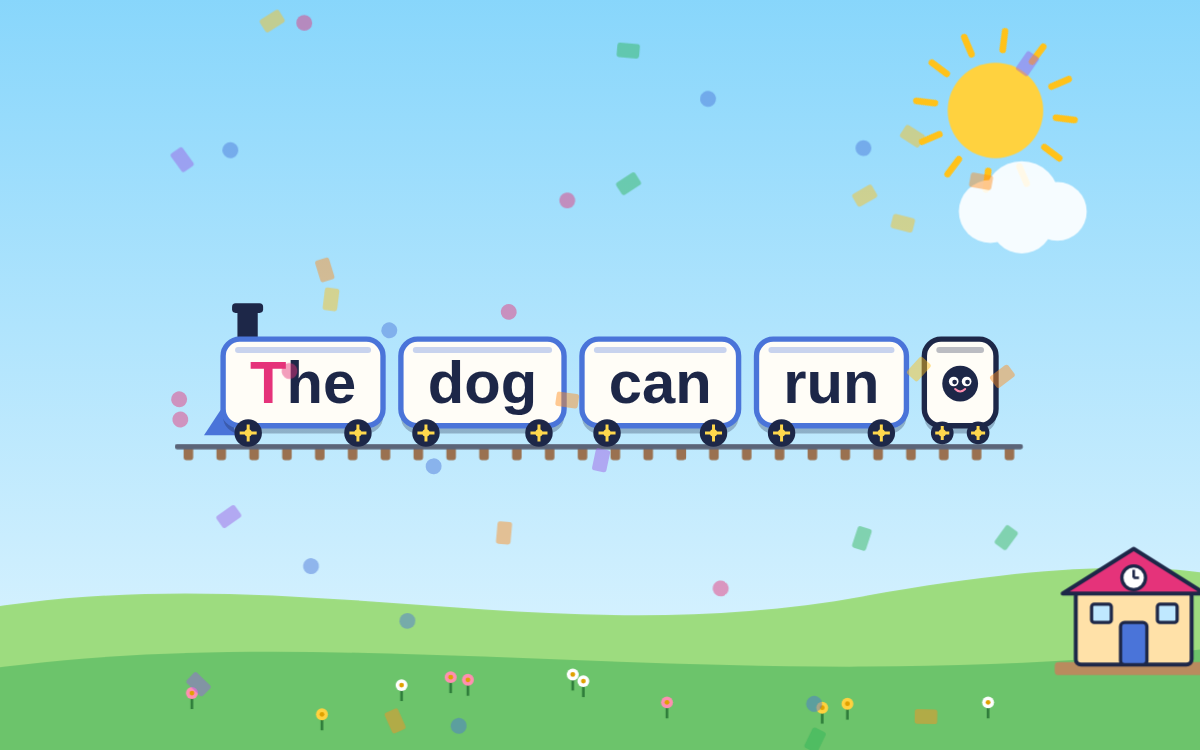
Dot the full stop guides each step, and a pointing hand shows what to tap. Children couple word carriages into sentence trains, turn small letters into capitals, fix names, places, days and the word I, help Buzzy the bee find where to stop, and build a bridge that joins two sentences with “and”.
Any word can be tapped to hear it spoken. A Star Mountain challenge checks everything at the end and awards a certificate.
Questions and answers
When do you use a capital letter?
You use a capital letter at the start of every sentence, for names of people and places, for days of the week and for the word I. In the game, children tap words like “sam” and “monday” to turn them into capitals.
Where does a full stop go in a sentence?
A full stop goes at the end of a sentence, where one complete idea finishes, and tells the reader to pause. When a line of words holds two ideas, each needs its own full stop, and the next sentence starts with a capital letter.
How do you join two sentences with “and”?
You join two sentences with “and” by removing the first full stop and putting “and” between the two ideas. The second idea then usually starts with a small letter, as in “The sun is hot and we go to the beach.”, but the word I always stays a capital.
What age is this capital letters and full stops game for?
It is made for children aged 5 to 7, matching Year 1 English in the National Curriculum for England. Older children who are still unsure about sentence punctuation can use it too, and Dot reads every instruction out loud for early readers.
How long does the game take and what does it include?
Playing everything takes about 35 minutes, and it can be split across several sessions because progress is saved. It includes five places on Sentence Island, 13 short activities, a six-question Star Mountain challenge and a certificate at the end.
Next in Grammar & Punctuation
See all
Types of Sentences: Build and Join Them on Sentence Island
Learn the four types of sentences and how to join ideas with because, when and if, by building sentences step…
Adverbs of Time, Place and Cause: Pip's Island Quest
Learn how adverbs of time, place and cause tell us when, where and why. Grow a sunflower, find a hiding kitte…
Prepositions and Conjunctions: A Busy Day with Pip
Learn prepositions and conjunctions for time, place and cause, then help Pip the robin and Mo the kitten buil…
Place Value to a Million: A Rocket Mission with Pip
Learn place value to a million and how to count in powers of 10. Build blocks, set digits on a place value ch…
How Computers Work: A Time Machine Adventure with Bit
Learn how computers work, from the abacus to the CPU. Travel through time with Bit, build a computer and foll…
Adding and Subtracting: Hop Along with Hopper the Frog
Learn adding and subtracting with number bonds, number lines and columns, then tap, hop and exchange counters…