
Adverbs of Time, Place and Cause
Pip's Island Quest
Learn how adverbs of time, place and cause tell us when, where and why. Grow a sunflower, find a hiding kitten and sort words with Pip the fox.
- Ages 7–9
- About 20 min
- 4 chapters + quiz
- Easy start
- Grammar & Punctuation
What's inside
- When? The sunflower
- Where? Hide and seek
- Why? Weather Hill
- Sort it! Adverb Stall
- Adverb Challenge 8 questions
What you'll learn
- What an adverb is and what job it does in a sentence
- Using time adverbs such as first, then, next, soon and later
- Spotting place adverbs such as upstairs, downstairs, outside and away
- How "therefore" shows cause by meaning "because of that"
- Sorting adverbs by whether they tell us when, where or why
- Choosing the right adverb to fill a gap in a sentence
About this adventure
Adverb Island is a free interactive game that teaches children aged 7–9 how adverbs of time, place and cause tell us when, where and why things happen. It follows the Year 3 English grammar curriculum.
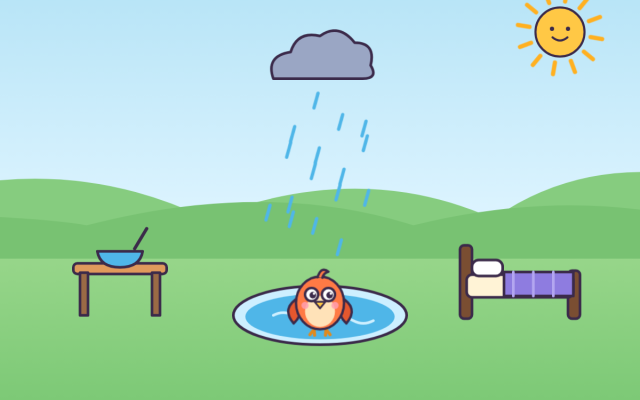
Pip the fox reads every step aloud. Children grow a sunflower to meet when words (first, then, next, soon, later), play hide and seek with Mittens the kitten to find where words (upstairs, downstairs, outside, away), and make it rain on Weather Hill to see how "therefore" links a reason to what happens next.
At the Adverb Stall, players drag each adverb into a when, where or why basket. An eight-question challenge then checks everything they have learned, lighting a lantern for each right answer. Colour-coded words and gentle hints help every child succeed.
Questions and answers
What is an adverb, in simple words?
An adverb is a word that tells us more about how, when, where or why something happens. In "Soon, the bus came", the adverb "soon" tells us when the bus arrived.
What are adverbs of time, place and cause?
Adverbs of time tell us when something happens, such as then, next or soon. Adverbs of place tell us where, such as upstairs or outside. Adverbs of cause, such as therefore, tell us why something happens.
How do you use "therefore" in a sentence for kids?
Use "therefore" to show that one thing happens because of another, and put it after the reason. For example: "It was cold. Therefore, I wore a hat." Here "therefore" means "because of that".
What age is this adverbs game for?
The game is designed for children aged 7 to 9. It matches the Year 3 English grammar curriculum in England, where pupils learn to express time, place and cause, and it also works well for revision in Year 4.
What does the Adverb Island game include and how long does it take?
Adverb Island has four guided activities and an eight-question challenge, which take about 20 minutes to play in full. Pip the fox narrates each step, and progress is saved so children can come back later.
Next in Grammar & Punctuation
See all

Place Value to a Million: A Rocket Mission with Pip
Learn place value to a million and how to count in powers of 10. Build blocks, set digits on a place value ch…
How Computers Work: A Time Machine Adventure with Bit
Learn how computers work, from the abacus to the CPU. Travel through time with Bit, build a computer and foll…
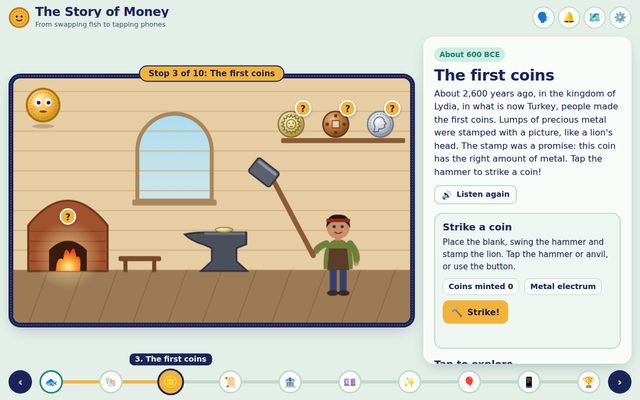
How Money Works: The Story from Barter to Bank Cards
Learn where money came from and how it works today: swap goods, mint coins, open a bank and tap to pay, one s…
Instruments of the Orchestra: Build It, Then Conduct It
Learn how the instruments of the orchestra make their sounds, then build all four families step by step and c…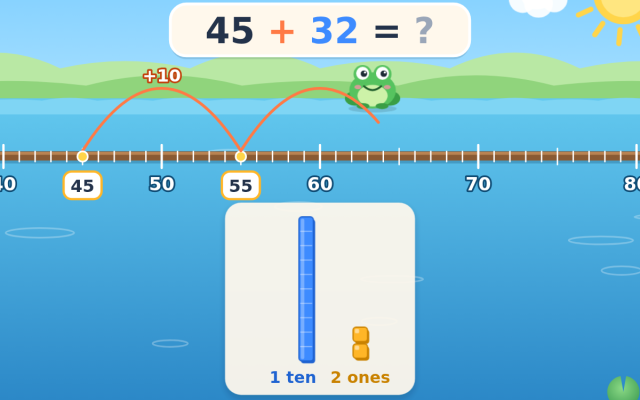
Adding and Subtracting: Hop Along with Hopper the Frog
Learn adding and subtracting with number bonds, number lines and columns, then tap, hop and exchange counters…
Multiplication and Division: Share, Group and Grow a Garden
Learn multiplication and division with equal groups, sharing, grouping and arrays, then help Dotty the ladybi…