Animal Life Cycles
Grow a Frog, Butterfly, Robin and Rabbit
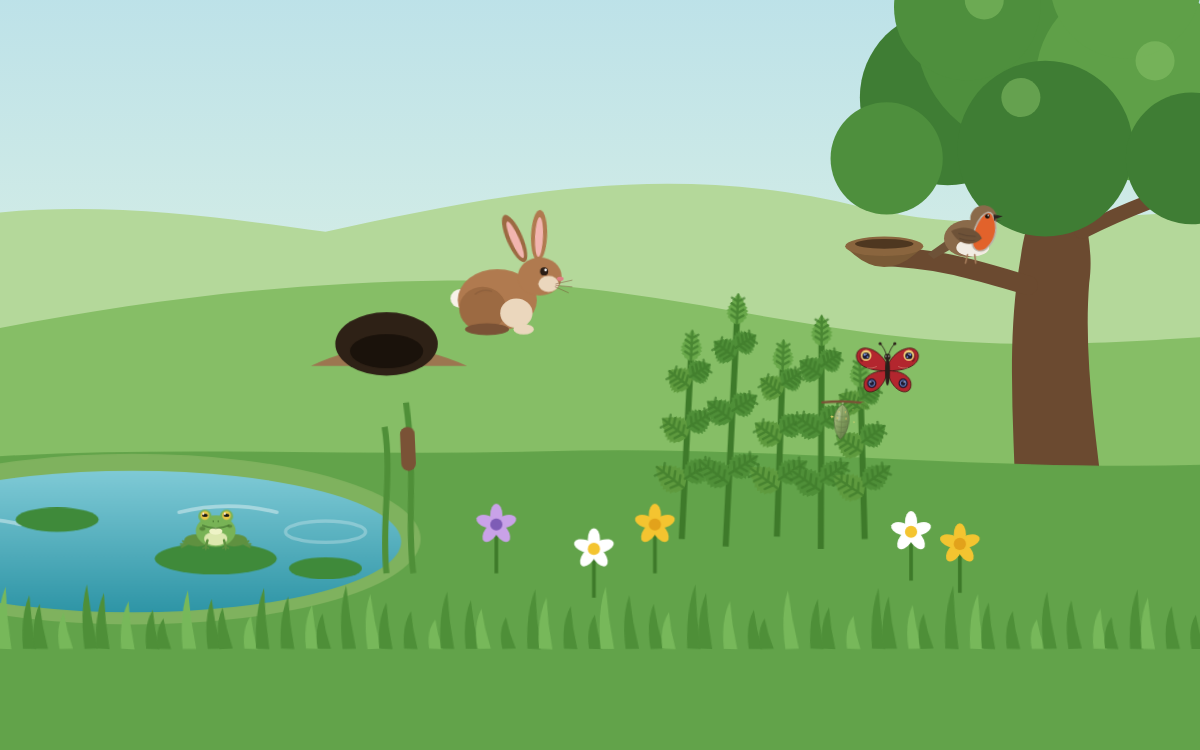
Learn how animal life cycles work by helping a frog, butterfly, robin and rabbit grow, from egg or birth to adult, one hands-on stage at a time.
- Ages 8–11
- About 25 min
- Easy start
- Animals & Nature
What you'll learn
- How a frog changes from frogspawn to tadpole, froglet and adult
- What metamorphosis means and which animals go through it
- The butterfly stages: egg, larva (caterpillar), pupa (chrysalis) and adult
- Why birds incubate their eggs and what a fledgling is
- How mammal babies grow inside their mother, then drink her milk
- Why animals that care for their young have fewer babies
About this adventure
Animal Life Cycles is a free interactive game that teaches children aged 8–11 how mammals, amphibians, insects and birds grow and change. It follows the Year 5 science topic of comparing life cycles.
Guided by Bramble the hedgehog, players make each stage happen: they tap to lay frogspawn, drag the sun across the sky to pass time, feed algae to tadpoles and leaves to a caterpillar, build a robin's nest and keep the eggs warm. Along the way they meet key terms such as metamorphosis, larva, pupa, incubation, gestation and fledgling, each explained in one short line.
A life-cycle strip fills in as every stage is reached, and a round-up asks players to compare the four animals. Instructions are read aloud, and the game works with touch, mouse or keyboard.
Questions and answers
What are the stages of a frog's life cycle?
A frog's life cycle goes from frogspawn to tadpole, then tadpole with legs, froglet and adult frog. The big change from a tadpole that breathes with gills to a frog with lungs is called metamorphosis.
How does a caterpillar turn into a butterfly?
A caterpillar eats, grows and sheds its skin several times, then forms a hard case called a chrysalis, or pupa. Inside, its body is rebuilt, and an adult butterfly pushes its way out and pumps its wings open.
How is a mammal's life cycle different from a bird's?
Most mammal babies grow inside their mother and are born alive, then drink her milk. Bird babies grow inside hard-shelled eggs that a parent keeps warm, which is called incubation, before hatching as chicks.
What age is the Animal Life Cycles game for?
It is designed for children aged 8 to 11 and matches the Year 5 science topic on life cycles. Instructions are short and read aloud, so younger children can also play with a little help.
What does the Animal Life Cycles game include, and how long does it take?
It has four guided chapters, for a frog, a butterfly, a robin and a rabbit, plus a round-up that compares them. Playing everything takes about 25 minutes, and each chapter can be played on its own.
Next in Animals & Nature
See all
Animal Habitats: Build a Woodland with Dotty the Ladybird
Discover how animal habitats give living things food, water and shelter, as you build a woodland, match anima…
Skeletons and Muscles: Build a Body with Skelly
Learn how skeletons and muscles work together: build a skeleton, test how bones protect you, and make an arm…
Place Value to a Million: A Rocket Mission with Pip
Learn place value to a million and how to count in powers of 10. Build blocks, set digits on a place value ch…
Adding and Subtracting: Hop Along with Hopper the Frog
Learn adding and subtracting with number bonds, number lines and columns, then tap, hop and exchange counters…
How Computers Work: A Time Machine Adventure with Bit
Learn how computers work, from the abacus to the CPU. Travel through time with Bit, build a computer and foll…
Instruments of the Orchestra: Build It, Then Conduct It
Learn how the instruments of the orchestra make their sounds, then build all four families step by step and c…