What you'll learn
- How vibration makes the sound in every instrument family
- Why shorter strings and tubes play a higher pitch
- How reeds, mouthpieces and valves shape woodwind and brass sounds
- The difference between tuned and untuned percussion
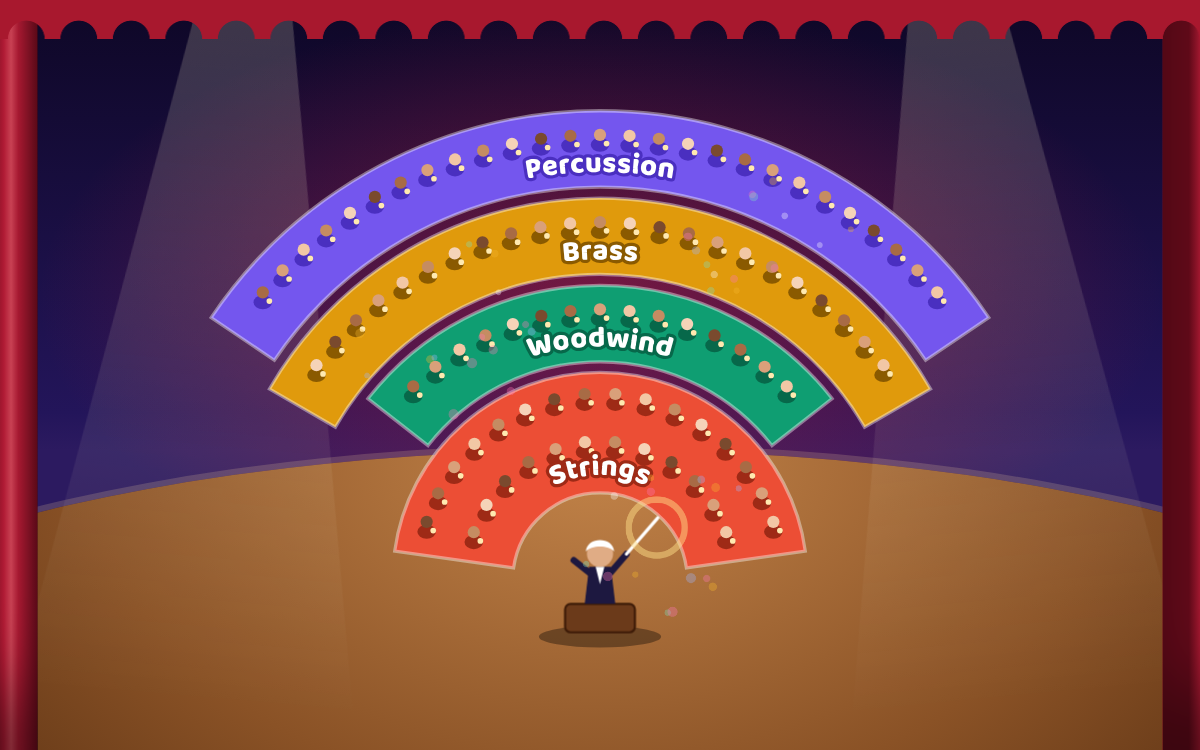
- Where the four families sit in an orchestra
- What texture, tempo and dynamics mean, including forte and piano
What's inside
- Open the curtains
- Build the strings
- Build the woodwind
- Build the brass
- Build the percussion
- Conduct your orchestra
About this adventure
Instruments of the Orchestra is a free interactive game that teaches children aged 7–11 how the strings, woodwind, brass and percussion families make their sounds. A friendly conductor speaks every instruction aloud, one short step at a time.
Children pluck and bow a single string, then slide a finger along it to hear the pitch rise. They blow across a bottle, buzz a reed, cover finger holes, buzz their lips into a mouthpiece, press trumpet valves, slide a trombone, tighten a timpani and sort tuned from untuned percussion. Every step shows vibration, the fast wobble behind all sound, and pitch, how high or low a note is.
Finally, they seat each family on stage and conduct Beethoven's Ode to Joy, resting families to hear the texture change and tapping for a faster or slower tempo and for forte (loud) or piano (quiet) dynamics.
Questions and answers
What are the four families of instruments in an orchestra?
The four families are strings, woodwind, brass and percussion. Each makes sound differently: strings vibrate, woodwind players blow across an edge or through a reed, brass players buzz their lips into a mouthpiece, and percussion is hit, shaken or scraped.
How do musical instruments make sound, in simple words?
Every instrument makes sound by making something vibrate, which means wobble very quickly. It might be a string, the air inside a tube, a player's lips or a drum skin. Faster vibrations make higher notes, so smaller instruments usually sound higher.
Why does a double bass sound lower than a violin?
A double bass sounds lower because its strings are much longer and thicker, so they vibrate more slowly and make a lower pitch. The same idea explains why a tuba, with about five metres of tube, sounds lower than a trumpet.
What age is this orchestra game for?
The game is made for children aged 7 to 11 and supports KS2 music. A narrator reads every instruction aloud, so less confident readers can play on their own, and it works well with a grown-up at home or on a classroom screen.
What does the orchestra game include and how long does it take?
It has an opening scene, four hands-on chapters, one for each instrument family, and a finale where children conduct Beethoven's Ode to Joy. Playing everything takes about 25 minutes, and finished chapters are saved so children can continue another time.
More to explore
See all
Place Value to a Million: A Rocket Mission with Pip
Learn place value to a million and how to count in powers of 10. Build blocks, set digits on a place value ch…
How Money Works: The Story from Barter to Bank Cards
Learn where money came from and how it works today: swap goods, mint coins, open a bank and tap to pay, one s…
How Computers Work: A Time Machine Adventure with Bit
Learn how computers work, from the abacus to the CPU. Travel through time with Bit, build a computer and foll…
Adding and Subtracting: Hop Along with Hopper the Frog
Learn adding and subtracting with number bonds, number lines and columns, then tap, hop and exchange counters…
Multiplication and Division: Share, Group and Grow a Garden
Learn multiplication and division with equal groups, sharing, grouping and arrays, then help Dotty the ladybi…