How Fossils Form: Dig Up Clues with Mary Anning
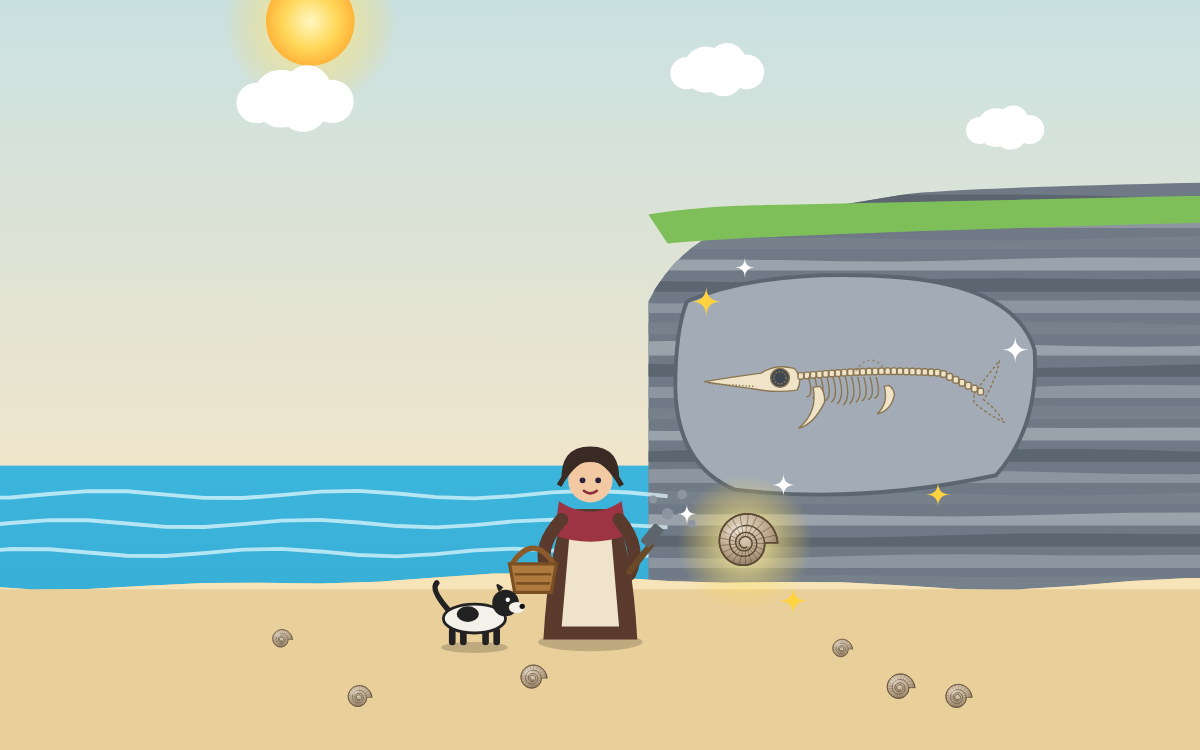
Learn how fossils form when living things are trapped in rock, then brush, dig and sort fossils from the seabed to Mary Anning's Jurassic Coast.
- Ages 7–9
- About 35 min
- Easy start
- Evolution & Fossils
Learn how fossils form when living things are trapped in rock, then brush, dig and sort fossils from the seabed to Mary Anning's Jurassic Coast.
How Fossils Form is an interactive science game that teaches children aged 7–9 how fossils form when living things are trapped in rock, and what fossils tell us about the past. It follows the Year 3 Rocks topic in the KS2 science curriculum.
Players let an ammonite sink to the seabed, wash sediment over it and hold a time button as the layers turn into sedimentary rock. They drag in minerals that turn the shell to stone, then wear the rock away and brush the fossil clean. Along the way they sort body fossils from trace fossils and make a mould and a cast.
As fossil detectives, they read rock layers, fossil teeth and sea shells found on mountains. Then they help Mary Anning dig out an ichthyosaur and rebuild a plesiosaur before a final challenge.
A fossil forms when a dead plant or animal is quickly buried by mud or sand. Its soft parts rot away, the layers slowly harden into rock, and minerals in water replace the hard parts, turning them to stone over thousands to millions of years.
A body fossil is part of the living thing itself, such as a bone, tooth or shell. A trace fossil shows something it did, such as a footprint, a burrow or fossilised poo, which scientists call coprolite.
Mary Anning was a fossil hunter from Lyme Regis in Dorset, born in 1799. When she was 12, she and her brother Joseph found an ichthyosaur, a giant sea reptile, and in 1823 she found the first complete plesiosaur skeleton.
The game is made for children aged 7 to 9 and matches the Year 3 Rocks topic in the KS2 science curriculum. Slightly older children who want a quick refresher on how fossils form will also find it useful.
It has five short chapters, an optional refresher on sediment, and a 10-question Fossil Hunter Challenge, all with spoken instructions. Playing everything takes about 35 minutes, and children can start any chapter from the main map.

 TapLearn
Getting it ready…
You've played chapter 1 for free. Ask a grown-up to make a free family account and become a member to open every chapter of every game.
Ask a grown-up to make a free family account and become a member to open every chapter of every game. There are lots of free games to play too!