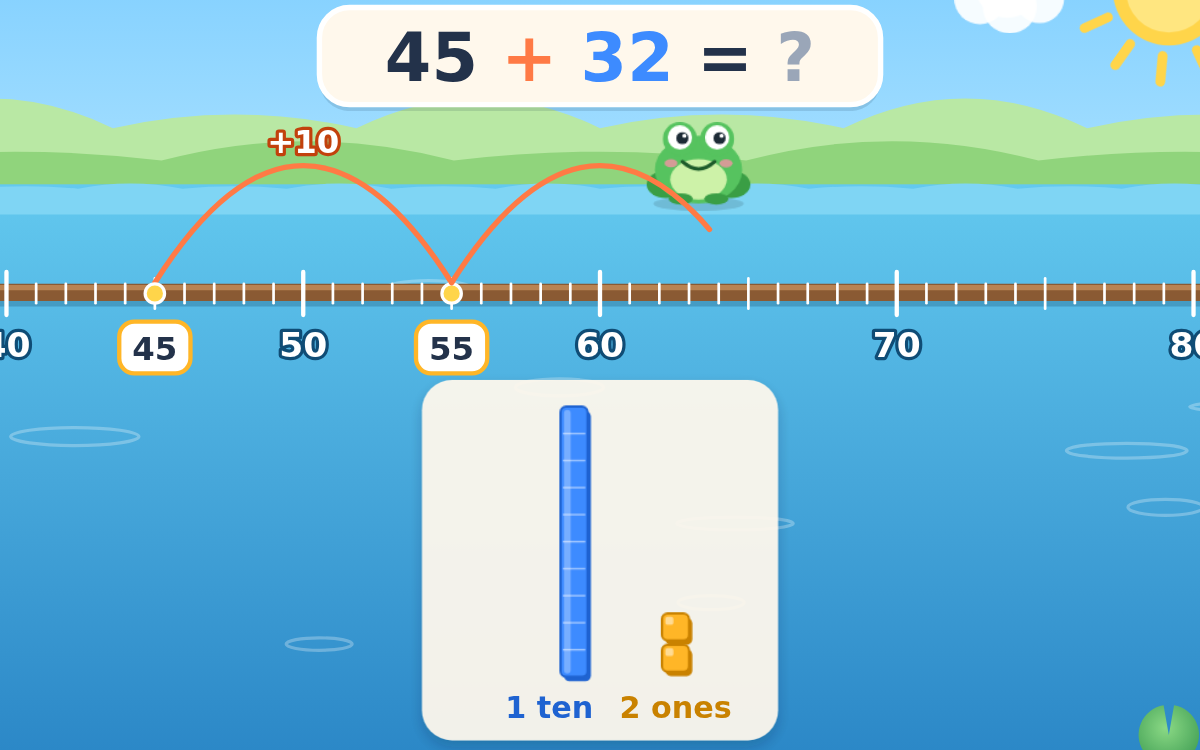
Adding and Subtracting: Hop Along with Hopper the Frog
Learn adding and subtracting with number bonds, number lines and columns, then tap, hop and exchange counters with Hopper the frog to solve sums.
- Ages 6–9
- About 25 min
- Some thinking
- Calculation
Learn adding and subtracting with number bonds, number lines and columns, then tap, hop and exchange counters with Hopper the frog to solve sums.
Adding and Subtracting is a free interactive game that teaches children aged 6–9 mental and written strategies for addition and subtraction. It follows the UK National Curriculum for Year 2 and Year 3.
Hopper the frog guides players through seven short adventures. They fill a ten frame to find number bonds to 10 and 100. They split numbers into tens and ones (partitioning) and hop along a number line to add and take away. They also discover that addition works in any order but subtraction does not, and count on to find the difference between two numbers.
Later adventures use a bar model to build a fact family and check answers with the inverse, the opposite operation. Place value counters sit beside the written column method, so children can see why 10 ones are exchanged for 1 ten. A Big Challenge of 8 mixed questions rounds everything off.
Number bonds to 10 are pairs of numbers that add up to 10, such as 6 and 4 or 3 and 7. Knowing them by heart helps children add quickly. It also helps them make 100, because 60 and 40 work in the same way.
Split the second number into tens and ones, then jump forward from the first number, tens first and ones second. For 34 + 23, you jump 10 twice to reach 54, then 3 ones to land on 57.
Exchanging means swapping 1 ten for 10 ones when a column does not have enough to take away. In 352 − 127, one ten is exchanged so the 2 ones become 12 ones, and 7 can then be taken away. Some people call this borrowing.
It is designed for children aged 6 to 9. It follows the UK National Curriculum for Year 2 (KS1) and Year 3 (KS2), moving from number bonds and mental methods to the written column method.
It has seven guided adventures and an 8-question Big Challenge, and playing everything takes about 25 minutes. Each adventure is short, so children can play one at a time, with spoken instructions and on-screen captions throughout.
Getting it ready…