How Computers Work: A Time Machine Adventure with Bit
Learn how computers work, from the abacus to the CPU. Travel through time with Bit, build a computer and follow a key press inside it.
- Ages 7–11
- About 20 min
- Easy start
- How Computers Work
Learn how computers work, from the abacus to the CPU. Travel through time with Bit, build a computer and follow a key press inside it.
How Computers Work is a free interactive game that teaches children aged 7 to 11 how computers developed over time and what happens inside one. Guided by Bit the robot, players count on an abacus, turn the crank of Charles Babbage's gear machine, switch on the glowing vacuum tubes of ENIAC and watch computers shrink to microchips and smartphones.
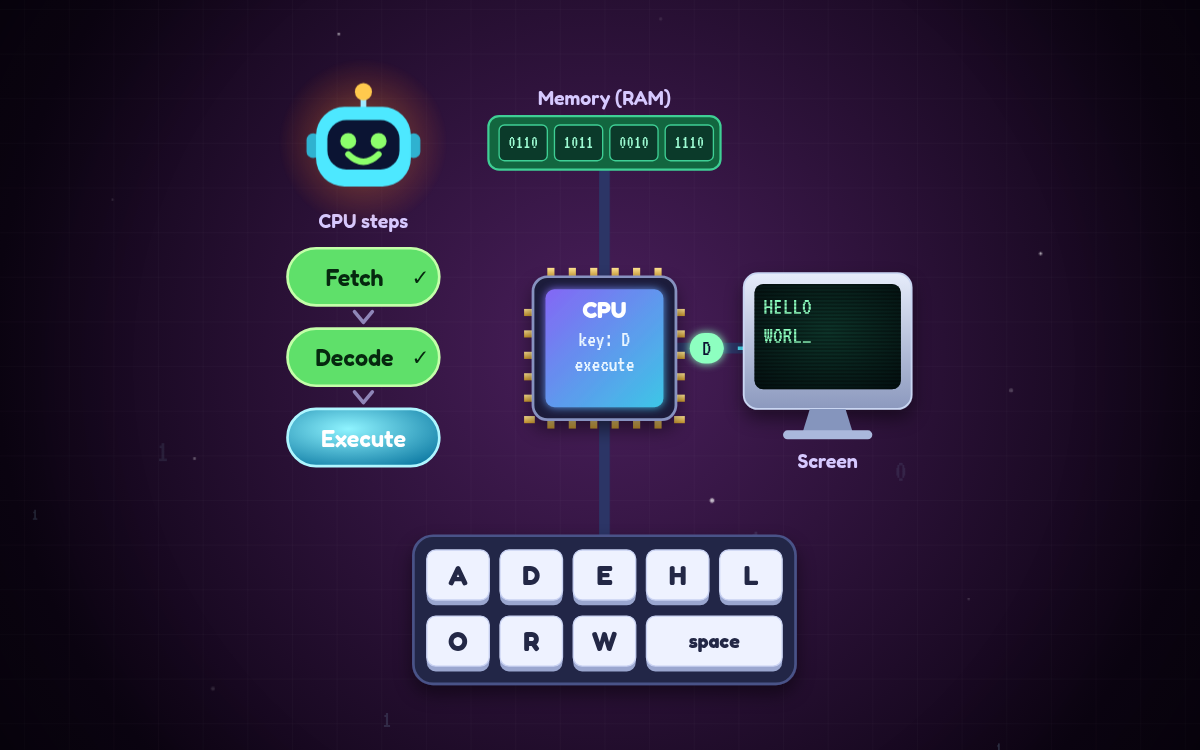
Next they explore a modern computer. They flip switches to make numbers in binary, where each on-or-off switch is a bit, and test AND and OR logic gates. They fit a CPU (the brain), RAM (short-term memory) and an SSD (long-term storage) onto a motherboard, then follow one key press as the CPU fetches, decodes and executes an instruction.
Bit gives one short spoken instruction at a time, with captions, so children learn by doing rather than reading.
A computer takes in information, follows instructions to process it, then shows or saves the result. The CPU does the thinking, RAM holds what it is working on right now, and storage such as an SSD keeps files even when the power is off.
Binary is a way of writing numbers using only 0 and 1. Computers use it because their tiny switches can only be off or on, so each switch stores one bit, and a group of eight bits, called a byte, is enough to store one letter.
There is no single first computer, because counting and calculating machines developed over thousands of years. Charles Babbage designed mechanical calculating machines in the 1820s, and ENIAC, completed in 1945, was one of the first general-purpose electronic computers.
The game is designed for children aged 7 to 11 and needs no previous computing knowledge. Bit reads every instruction aloud and shows it as a caption, so younger children can also enjoy it alongside an adult.
The game takes about 20 minutes to play from start to finish. It has ten short stops, from the abacus and ENIAC to binary, logic gates, building a computer and a key press, and progress is saved so children can carry on later.
Getting it ready…