What's inside
- The Apple Stall
- The Legion Camp
- The Gate Builder
- The Story of Zero
- The Arena 10 questions
What you'll learn
- The values of the five symbols I, V, X, L and C
- Why a smaller symbol after a bigger one means add
- How a small symbol before a bigger one subtracts, as in IX
- Why a symbol is never written more than three times in a row
- How to write numbers to 100 by writing tens, then ones
- Why Roman numerals had no zero and how place value helps
About this adventure
Roman Numerals is a free interactive game that teaches children aged 7–10 how to read Roman numerals from I to C and how the number system works. A young Roman soldier called Cato talks them through every step.
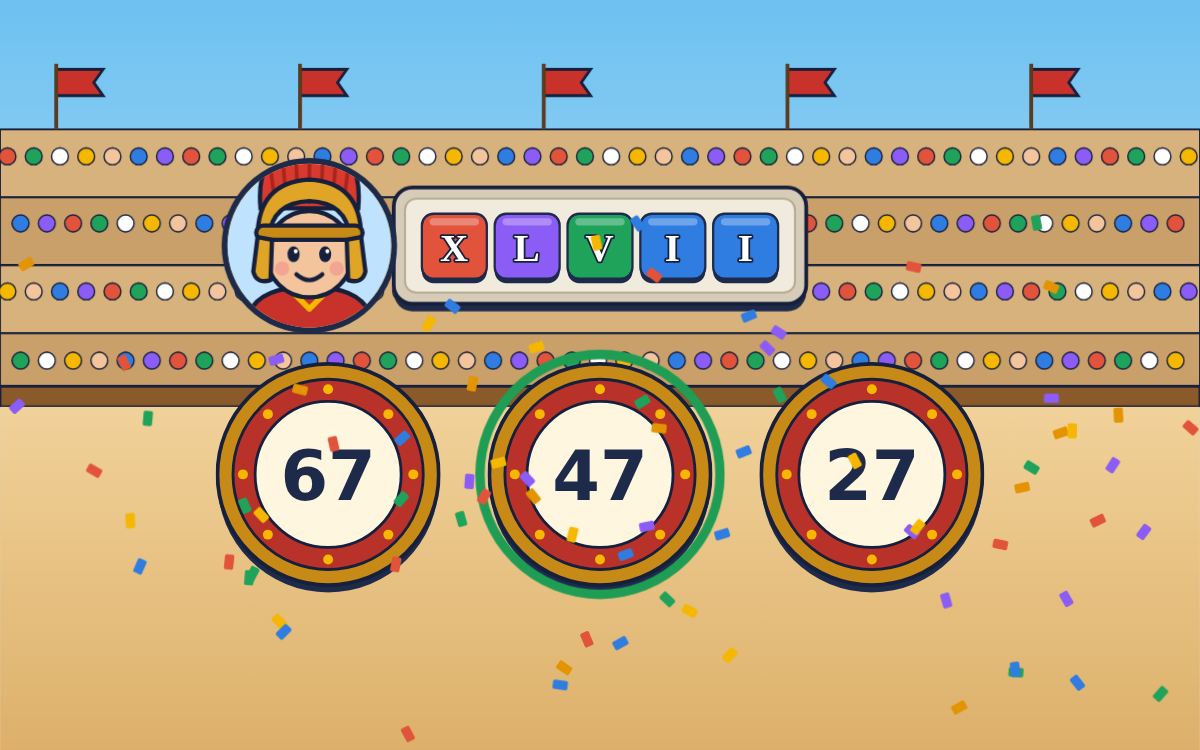
Players count apples at a market stall to meet I, V and X, then call squads of soldiers to discover L (50) and C (100). They find out that a smaller symbol after a bigger one is added (VI is 6), but one placed before it is subtracted (IV is 4). At the Colosseum they build gate numbers tens first, then ones: XL and VII make XLVII, or 47.
The story of zero shows why the Romans had no symbol for zero and how place value lets us write 38 with two digits instead of seven symbols. A ten-round arena challenge then checks what they have learned.
Questions and answers
How do Roman numerals work, in simple words?
Roman numerals use letters to stand for numbers: I is 1, V is 5, X is 10, L is 50 and C is 100. When the symbols go from biggest to smallest you add them, so VI is 6 and LX is 60.
Why is 4 written as IV in Roman numerals?
4 is written as IV because a smaller symbol placed before a bigger one is taken away, so IV means 5 take away 1. The usual rule is not to repeat a symbol four times in a row, so IIII is not the standard way to write it.
Did the Romans have a symbol for zero?
No, the Romans had no symbol for zero. Mathematicians in India were using zero as a number about 1,400 years ago, and it later spread to Europe, where it made place value possible.
What age is this Roman numerals game for?
The game is designed for children aged 7 to 10. It matches the national curriculum in England, where pupils read Roman numerals on clocks in Year 3 and read them up to 100 in Year 4.
What does the Roman numerals game include and how long does it take?
The game has four guided chapters and a ten-round arena challenge, and takes about 25 minutes to play through. Children tap and drag objects to build each number themselves while Cato explains what is happening.
Next in Numbers
See all

Prime, Square and Cube Numbers: A Number Explorer Quest
Learn prime, square and cube numbers, plus factors and multiples, by planting seeds, hopping frogs and buildi…
Powers and Standard Form: A Mission from Atom to Galaxy
Learn powers and standard form, square roots and index laws by building them by hand on a guided space missio…
Negative Numbers: Count Back Through Zero with Pip
Learn what negative numbers are and how to count back through zero, by hopping along an ice number line, read…
Place Value: Tens and Ones Adventure with Ollie the Owl
Learn place value with tens and ones: bundle cubes into tens, build and split numbers to 100, and compare the…
Place Value: Build Numbers to 1,000 with Digit the Robot
Learn place value with hundreds, tens and ones to 1,000. Turn ones into tens in a block machine, build number…
Comparing and Ordering Numbers: Feed Chompy the Croc
Learn all about comparing and ordering numbers to 100 with and =, then feed a hungry crocodile, hop a frog al…