What's inside
- Count on
- Count back
- Count in 2s
- Count in 5s
- Count in 10s
- 100 square
- Challenge 8 questions
What you'll learn
- Count on to 100 from any number, crossing each new ten
- Count back from 10 to 0 and from 20 to 10
- Count in 2s, 5s and 10s using pairs, starfish and towers
- Follow jumps of 2, 5 or 10 along a number line
- Use a hundred square to find ten more and spot patterns
- Work out one more, one less and missing numbers
About this adventure
Counting to 100 with Pip is a free interactive game that teaches children aged 4–7 to count to 100 forwards and backwards, and to count in 2s, 5s and 10s. It follows the Year 1 maths curriculum for England.
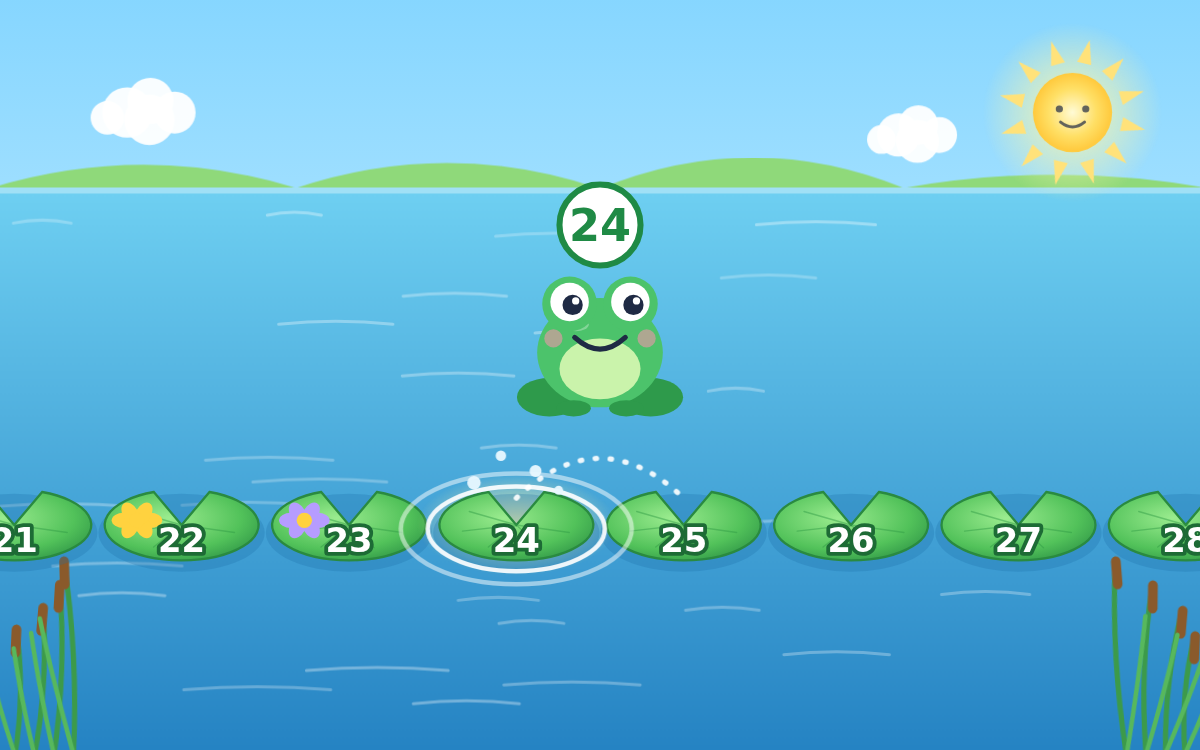
Children follow Pip the frog through short lessons on a map. They hop along lily pads to count on, crossing each new ten, and drain a rocket's fuel from 10 to 0 to count back one less at a time. Pairs of socks, starfish arms and towers of ten cubes introduce skip counting, which means jumping in equal steps, and a number line marks each jump.
A hundred square shows that the number directly below is ten more. A final challenge asks what comes next, what is missing, and what is one more or one less. Pip reads every instruction aloud, and a pointing hand appears if a child gets stuck.
Questions and answers
How do you teach a child to count to 100?
Most children learn to count to 100 by mastering 1 to 10 first, then noticing that every new ten follows the same pattern. Practising the tricky changes, such as 29 to 30, and pointing to numbers on a hundred square both help.
What does counting in 2s, 5s and 10s mean?
Counting in 2s, 5s and 10s means saying every second, fifth or tenth number, such as 2, 4, 6 or 5, 10, 15. It is also called skip counting, and it lays the groundwork for learning times tables.
Why do young children find counting backwards harder?
Counting backwards is harder because children have to work out the number that is one less, rather than reciting a sequence they already know by heart. Short countdowns like 10 to 0, with numbers they can see, make it easier.
What age is this counting to 100 game for?
This game is designed for children aged 4 to 7. It matches Year 1 in England, where children learn to count to and across 100, forwards and backwards. Older children who need extra practice can enjoy it too.
What does the game include and how long does it take?
The game has seven stops on Pip's map: counting on, counting back, counting in 2s, 5s and 10s, a hundred square and an 8-question challenge. Playing everything takes about 30 minutes, and each stop can be played on its own.
Next in Numbers
See all
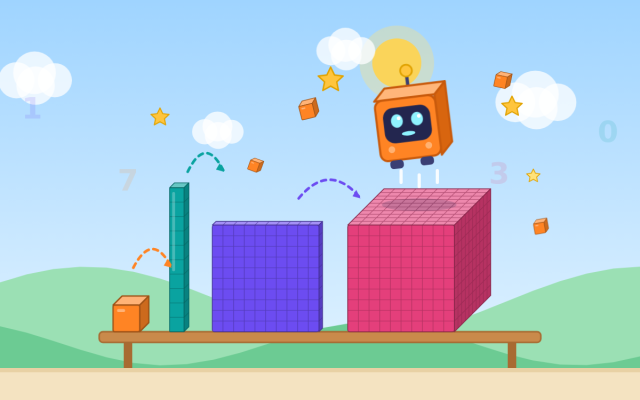
Place Value: Build Numbers to 1,000 with Digit the Robot
Learn place value with hundreds, tens and ones to 1,000. Turn ones into tens in a block machine, build number…
Comparing and Ordering Numbers: Feed Chompy the Croc
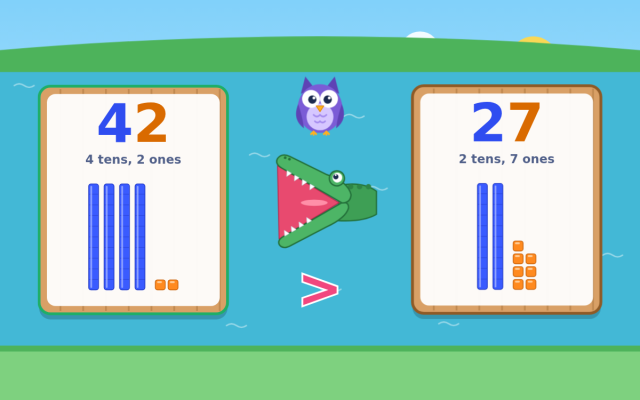
Learn all about comparing and ordering numbers to 100 with and =, then feed a hungry crocodile, hop a frog al…
Place Value to a Million: A Rocket Mission with Pip
Learn place value to a million and how to count in powers of 10. Build blocks, set digits on a place value ch…
Adding and Subtracting: Hop Along with Hopper the Frog
Learn adding and subtracting with number bonds, number lines and columns, then tap, hop and exchange counters…
How Computers Work: A Time Machine Adventure with Bit
Learn how computers work, from the abacus to the CPU. Travel through time with Bit, build a computer and foll…
Instruments of the Orchestra: Build It, Then Conduct It
Learn how the instruments of the orchestra make their sounds, then build all four families step by step and c…