What's inside
- Factor Forest
- Multiples Meadow
- Prime Peaks
- Square Garden
- Cube Castle
- Challenge Arena 8 questions
What you'll learn
- What a factor is and how to find all factor pairs
- How to spot common factors and the highest common factor
- What multiples are and how to find the lowest common multiple
- Why a prime number has exactly two factors
- How to split a number into its prime factors
- What square and cube numbers are, and what ² and ³ mean
About this adventure
Prime, Square and Cube Numbers is a free interactive maths game that teaches children aged 8–11 about factors, multiples, prime numbers, square numbers and cube numbers. A friendly guide called Pip reads each step aloud and gives one short instruction at a time.
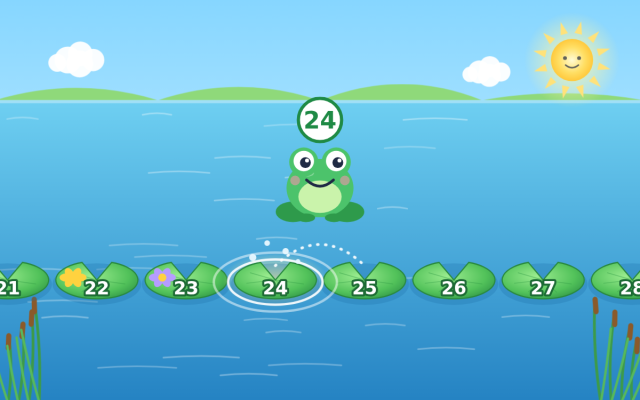
Players share 12 counters into equal rows to find factor pairs, then sort the common factors of 12 and 18. They follow two hopping frogs to discover common multiples, and cross out numbers on a grid to sieve out every prime up to 30. A prime number has exactly two factors; a composite number has more.
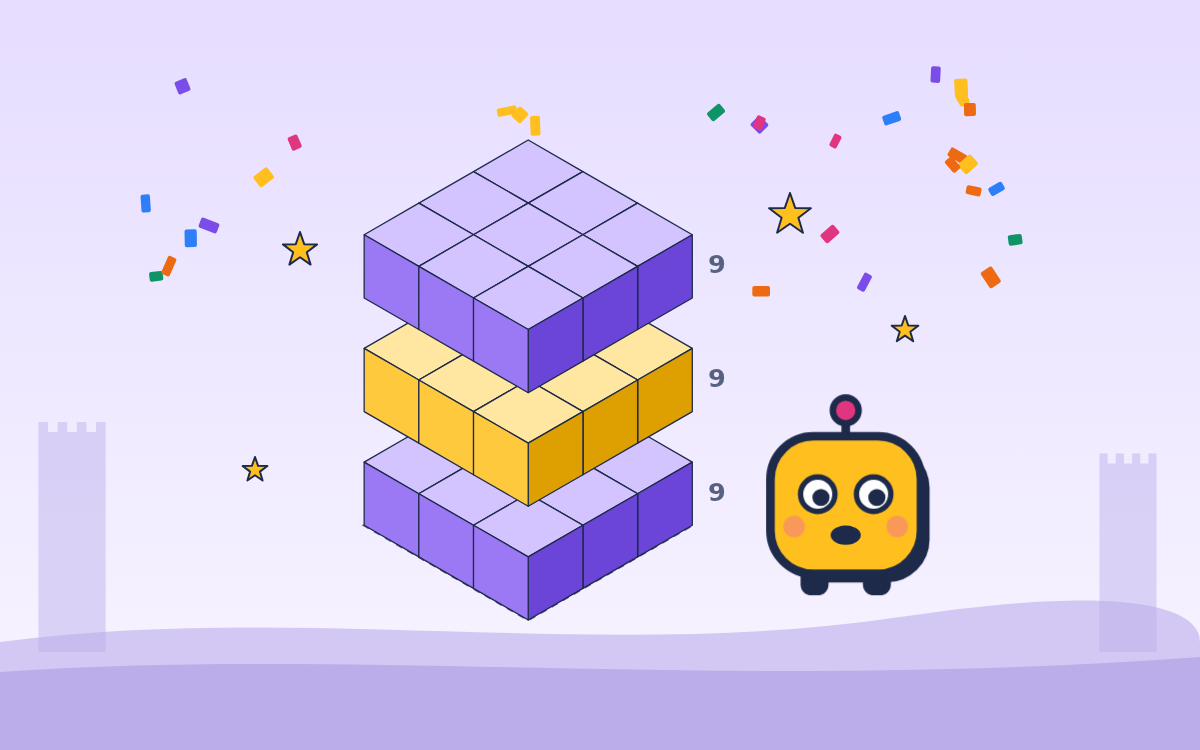
Children also split 12 into a factor tree to find its prime factors, grow a garden of tiles to see why 4² means 4 × 4, and build 3³ from three layers of nine cubes. An eight-question challenge checks what they have learned.
Questions and answers
What is a prime number, in simple words?
A prime number is a whole number greater than 1 that has exactly two factors: 1 and itself. For example, 7 is prime because only 1 × 7 makes 7, but 6 is not prime, because 2 × 3 also makes 6.
What is the difference between a factor and a multiple?
A factor divides into a number exactly, while a multiple is the answer you get when you multiply a number by a whole number. So 3 is a factor of 12, and 12 is a multiple of 3, because 3 × 4 = 12.
What are square numbers and cube numbers?
A square number comes from multiplying a number by itself, such as 4² = 4 × 4 = 16. A cube number comes from multiplying three of the same number together, such as 3³ = 3 × 3 × 3 = 27. Square numbers make squares of tiles, and cube numbers make cubes.
What age is this prime numbers game for?
It is designed for children aged 8 to 11 and matches the Year 5 maths curriculum in England, where pupils learn about factors, multiples, primes, square numbers and cube numbers. Younger children who know their times tables can enjoy it with an adult.
What does the game include and how long does it take?
The game has five guided adventures (Factor Forest, Multiples Meadow, Prime Peaks, Square Garden and Cube Castle) plus an eight-question Challenge Arena. Playing everything takes about 30 minutes, and progress is saved so children can carry on later.
Next in Numbers
See all
Powers and Standard Form: A Mission from Atom to Galaxy
Learn powers and standard form, square roots and index laws by building them by hand on a guided space missio…
Negative Numbers: Count Back Through Zero with Pip
Learn what negative numbers are and how to count back through zero, by hopping along an ice number line, read…
Roman Numerals: A Quest Through Ancient Rome with Cato
Learn to read Roman numerals from I to C by counting apples, calling up Roman soldiers, opening Colosseum gat…
Place Value: Tens and Ones Adventure with Ollie the Owl
Learn place value with tens and ones: bundle cubes into tens, build and split numbers to 100, and compare the…
Place Value: Build Numbers to 1,000 with Digit the Robot
Learn place value with hundreds, tens and ones to 1,000. Turn ones into tens in a block machine, build number…
Comparing and Ordering Numbers: Feed Chompy the Croc
Learn all about comparing and ordering numbers to 100 with and =, then feed a hungry crocodile, hop a frog al…