
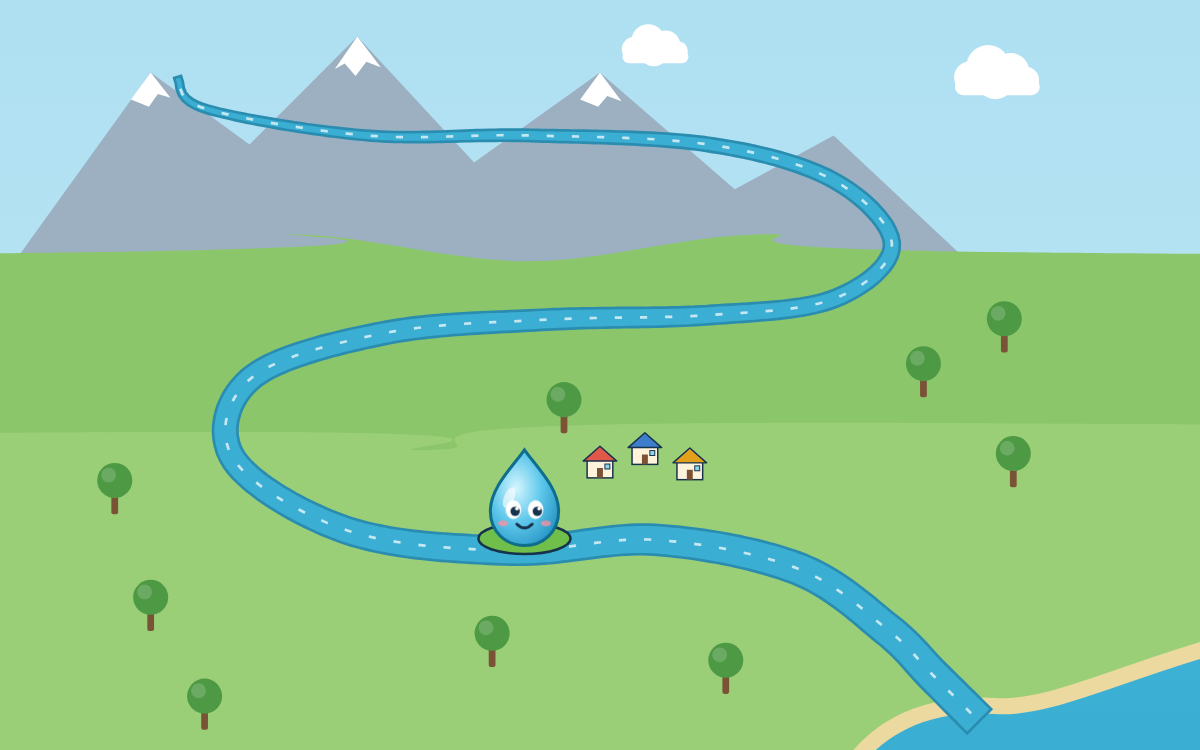
Rivers from Source to Sea
Follow Pip the Raindrop
Learn how rivers flow from source to sea, wear away the land and build new landforms. Make a river, carve a waterfall and grow an oxbow lake.
- Ages 7–11
- About 50 min
- 7 chapters + quiz
- Some thinking
- Rivers, Coasts & Mountains
What's inside
- Where rivers begin
- Downhill all the way
- Pick up, carry, drop
- The mountain stream
- Bends and loops
- Journey to the sea
- Rivers and people
- River Champion challenge 7 questions
What you'll learn
- How the water cycle feeds a river at its source
- The parts of a river: source, tributary, confluence and mouth
- Erosion, transportation and deposition, and the four ways rivers carry their load
- How waterfalls, plunge pools and gorges form in the upper course
- How meanders grow and turn into oxbow lakes
- How floodplains, deltas and estuaries form, and why people settle by rivers
About this adventure
Rivers from Source to Sea is a free interactive game that teaches children aged 7–11 how rivers begin, flow downhill and shape the land, following the KS2 geography curriculum. Players guide Pip the raindrop through eight stops, from a river's source in the hills to its mouth at the sea.
Each idea is built by hand: joining tributaries at a confluence, using a speed lever to see erosion, transportation and deposition, carving a V-shaped valley and a waterfall with a plunge pool and gorge, and growing a meander until a flood leaves an oxbow lake. Later, players flood a floodplain, build a delta and watch the Severn Bore surge up an estuary.
They also build a riverside town and protect it from floods. A narrator reads every instruction aloud, and a final challenge checks what they remember.
Questions and answers
Where does a river start?
A river starts at its source, usually high in hills or mountains, where rain, melting snow or an underground spring supplies the water. From there it always flows downhill until it reaches the sea or a lake at its mouth.
How is a waterfall formed, in simple words?
A waterfall forms where a river flows over a layer of hard rock lying on top of softer rock. The soft rock wears away faster, leaving an overhang that eventually collapses, so the waterfall slowly moves back upstream and leaves a steep gorge.
What is an oxbow lake and how does it form?
An oxbow lake is a horseshoe-shaped lake that used to be a bend, or meander, in a river. During a flood the river cuts through the narrow neck of land, takes a shortcut, and sand then seals off the old loop.
What age is this rivers game suitable for?
The game is designed for children aged 7 to 11, matching the rivers topic in KS2 geography (Years 3 to 6). Every instruction is read aloud, so younger or less confident readers can still follow along.
What does the rivers game include and how long does it take?
It has eight stops: seven hands-on lessons covering a river's journey and how people use rivers, plus a final quiz challenge. Each stop takes about five to eight minutes, so the whole game takes roughly 50 minutes, and players can start at any stop.
Next in Rivers, Coasts & Mountains
See all
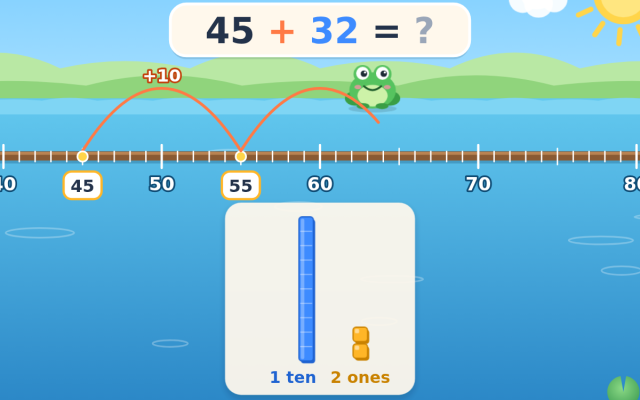
Adding and Subtracting: Hop Along with Hopper the Frog
Learn adding and subtracting with number bonds, number lines and columns, then tap, hop and exchange counters…
How Computers Work: A Time Machine Adventure with Bit
Learn how computers work, from the abacus to the CPU. Travel through time with Bit, build a computer and foll…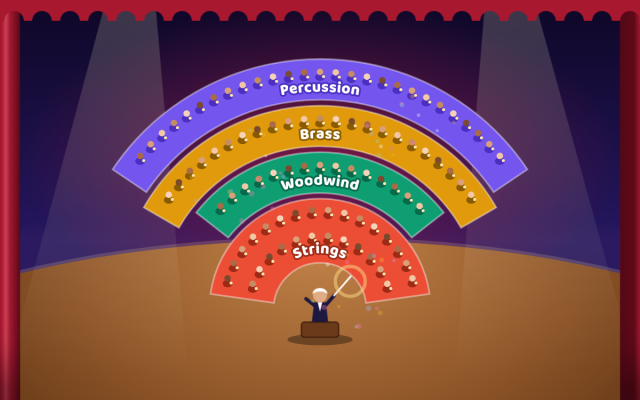
Instruments of the Orchestra: Build It, Then Conduct It
Learn how the instruments of the orchestra make their sounds, then build all four families step by step and c…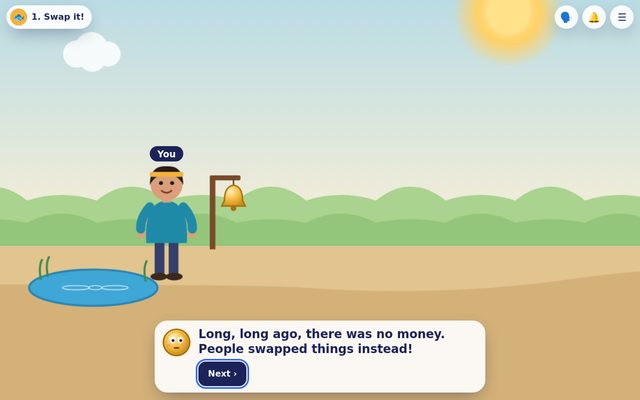
How Money Works: The Story from Barter to Bank Cards
Learn where money came from and how it works today: swap goods, mint coins, open a bank and tap to pay, one s…
Multiplication and Division: Share, Group and Grow a Garden
Learn multiplication and division with equal groups, sharing, grouping and arrays, then help Dotty the ladybi…
Adverbs of Time, Place and Cause: Pip's Island Quest
Learn how adverbs of time, place and cause tell us when, where and why. Grow a sunflower, find a hiding kitte…