How Magnets Work: A Magnet Lab Adventure with Maxi
Learn how magnets work: which materials they attract, what north and south poles do, and when magnets attract or repel, through hands-on lab experiments.
Why a magnet's pull is a non-contact force that works at a distance
Which materials are magnetic, and why not all metals stick
That every magnet has a north pole and a south pole
Why a magnet's pull is strongest at its poles
How to predict whether two magnets will attract or repel
How compasses, recycling cranes and maglev trains use magnets
What's inside
The Invisible Pull
Magnetic or Not?
Meet the Poles
Attract or Repel?
Magnets at Work
Magnet Master Challenge (8 questions)
About this adventure
How Magnets Work is an interactive science game that teaches children aged 7–9 which materials magnets attract, what a magnet's north and south poles do, and when two magnets attract or repel. It follows the Year 3 forces and magnets topic in the KS2 science curriculum.
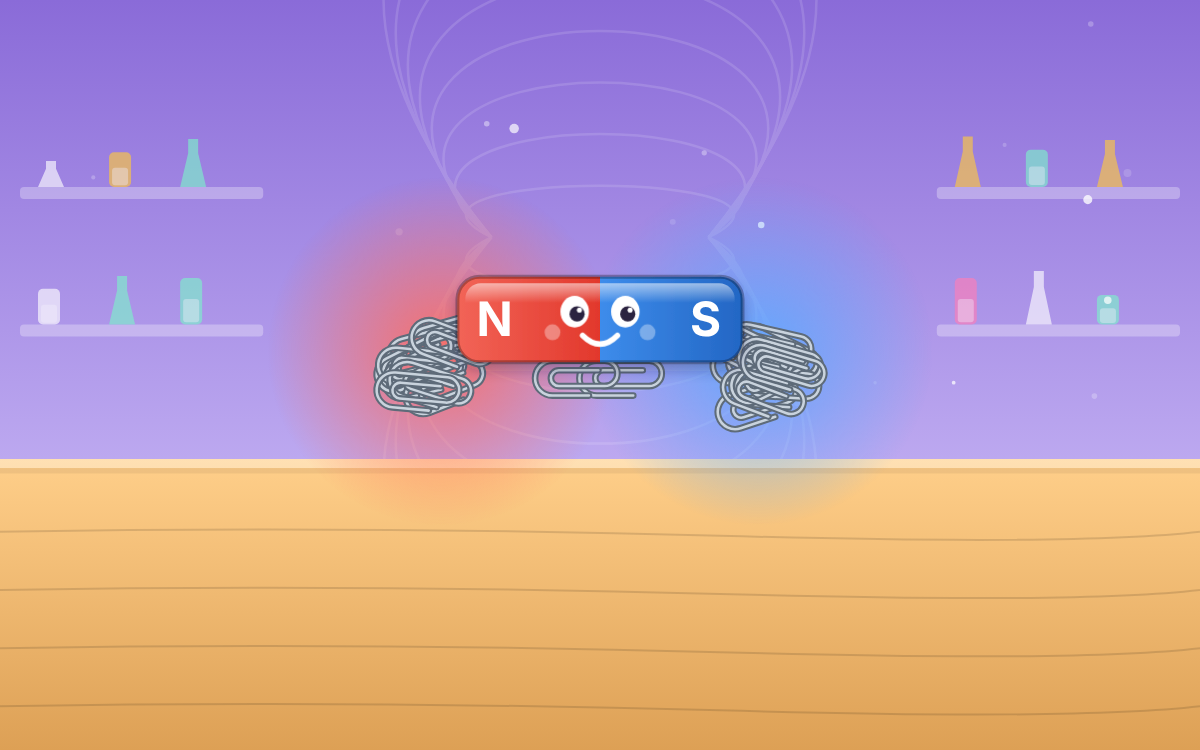
Guided by Maxi, a friendly bar magnet, players pull a paperclip across a gap to discover a non-contact force (a push or pull that works without touching) and use magic goggles to see the magnetic field. They predict, then test, everyday objects and find that an aluminium can and a gold ring are metal but not magnetic.
Later chapters show that the pull is strongest at the poles, that bigger magnets are not always stronger, and that only a magnet can repel another magnet. Players then drive a recycling crane, follow a compass and float a maglev train before an eight-question challenge.
Questions and answers
How do magnets work, in simple words?
A magnet pulls on certain metals, such as iron and steel, without touching them, using an invisible area of force called a magnetic field. Every magnet has a north pole and a south pole, and its pull is strongest at these two ends.
Are all metals magnetic?
No, only a few metals are magnetic, mainly iron, steel, nickel and cobalt. Aluminium, gold and copper are metals but are not attracted to a magnet, which is why recycling centres can use magnets to pull steel tins away from aluminium cans.
Why do magnets attract or repel each other?
Magnets attract when different poles face each other, north to south, and repel when the same poles face each other, north to north or south to south. Only another magnet can push a magnet away, so repelling is a good test for a hidden magnet.
What age is this magnets game for?
It is designed for children aged 7 to 9 and matches the Year 3 forces and magnets topic in the KS2 science curriculum in England. Every instruction is read aloud and shown as a short caption, so less confident readers can play too.
What does the magnets game include and how long does it take?
It has five hands-on chapters and a final eight-question challenge, taking about 35 minutes in total. Children test objects, find poles, float a magnet that points north, drive a recycling crane and float a maglev train, choosing any chapter from the lab.

 TapLearn